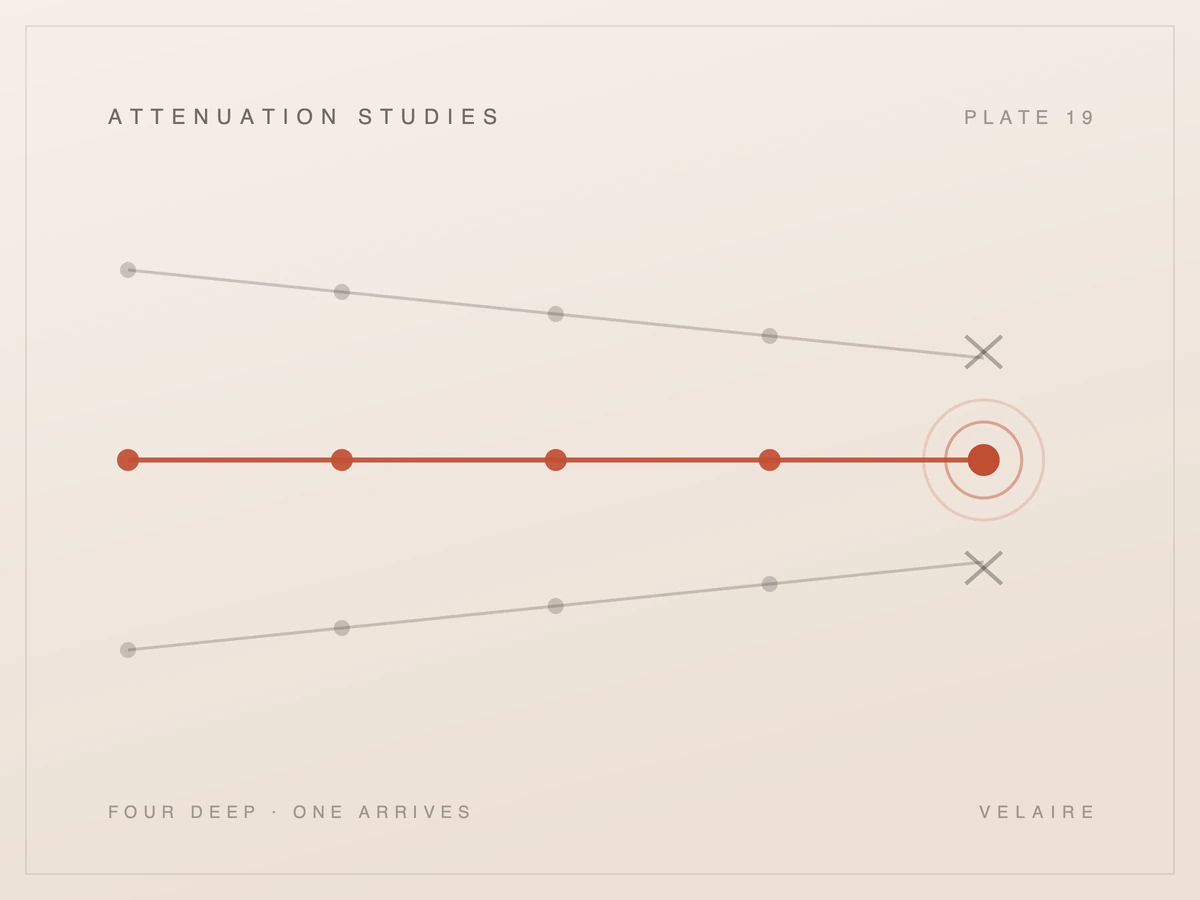
A caller who abandons a queue reached you, waited, and left anyway. That is a different failure from nobody answering, it has different causes, and after-hours coverage does nothing whatsoever about it.
11:10am, three in the queue
the one person covering both
Before you start
- •A call export that distinguishes abandoned from unanswered, or a phone system that can
- •Your staffing rota for the same period
- •Access to your hold music and hold messaging settings
- •About 3 hours, then 30 minutes a month
What you will end up with
- •Abandoned and rang out are different failures with different fixes, and most reports bundle them.
- •Your own abandonment curve gives a practical hold ceiling, commonly somewhere around 90 seconds.
- •The shortage is almost never general: expect 2 or 3 recurring windows where volume is high and free cover is low.
- •Silence on hold reads as a dropped call within about 15 seconds, and fixing that is free.
- •A callback or text-back option only helps if it lands in a queue somebody actually owns.
Most writing about missed calls is about the hours nobody is there. This guide is about the other kind, and it is the kind practices are more responsible for: the caller who rang during opening hours, reached your system, waited, and hung up.
That caller is a different problem in every respect. They found you, they were willing to wait, and something about the waiting was worse than the alternative. No amount of evening coverage addresses it, and a practice that buys coverage to fix it will get an accurate report showing the evenings are now handled and a queue that is exactly as bad as it was.
Seven lessons, about 3 hours, then 30 minutes a month to see whether it worked. Most of the fixes cost nothing.
What abandonment actually measures#
Abandonment is the share of callers who reached your queue and left before speaking to anybody. It is a measure of patience running out, which makes it a measure of the gap between how long people will wait and how long you make them wait.
Both halves of that gap move. The tolerable wait depends on why they are calling, what time it is, and whether they have alternatives, and the actual wait depends on your volume and your cover. A practice can improve the number by shortening the wait or by making the wait more tolerable, and the second is usually cheaper.
There is a reason this number is neglected relative to the after-hours one, and it is not that it matters less. After-hours misses have a comfortable explanation: nobody was there. Abandonment during opening hours implies that somebody was there and the caller left anyway, which reads as a judgement on the team rather than on the arrangement. It is not one, and treating it as one is how the number goes unexamined for years.
It is worth separating from the total missed-call figure immediately, because the two behave differently and respond to different things.
A caller who abandons found you and left anyway. That is a harder failure than not being there.
There is an external number to aim at, and it does not come from anyone selling telephony. A 2022 study of 6 Veterans Affairs medical centres chosen for above-average primary care access records the standard those sites were held to: an average speed of answer of 30 seconds or less, and call abandonment under 5% [3]. A staffed call centre with a mandate is not a small practice, so treat 5% as the direction rather than the deadline. Most practices measuring for the first time land far enough above it that the gap, not the target, is the finding.
01Separate abandoned from rang out#
Your phone system's missed-call number bundles at least two very different events, and everything in this guide depends on splitting them before you do anything else.
| Disposition | What happened | Whose problem |
|---|---|---|
| Rang out | Nobody picked up, no queue involved | Coverage or rota |
| Abandoned in queue | Caller reached the queue and left | Wait time and hold experience |
| Voicemail left | Caller chose to leave a message | A task, not a loss |
| Under 10 seconds | Misdial or hang-up before connection | Neither, drop these |
Only the second row belongs to this guide. Pull it out as its own number, expressed as a percentage of calls that entered the queue, and track it separately from now on.
The split frequently surprises people. A practice convinced it has an after-hours problem sometimes finds most of its misses are abandonment during staffed hours, which is a completely different project with a much cheaper fix. The reverse is also common.
Express the abandonment figure as a share of calls that entered the queue rather than of all inbound calls. Using total inbound as the denominator dilutes it with calls that were answered immediately and never queued at all, which makes a real problem look small and makes month-to-month comparison meaningless as your volume moves.
If your phone system cannot distinguish the two, that is worth fixing first and is usually a configuration option rather than an upgrade. Without it, you are guessing at which of two unrelated problems you have.
02Find your own abandonment curve#
The curve is the relationship between wait time and the share of callers who give up, and it is specific to your practice. Published averages are useless here because the tolerable wait depends entirely on who your callers are and what they are calling about.
- Export a month of queued calls with the wait duration on each.
- Bucket them: under 30 seconds, 30 to 60, 60 to 120, 120 to 180, over 180.
- For each bucket, compute the share that abandoned.
- Plot it, even roughly on paper. You are looking for the point where the line turns upward.
- Write that number down. It is your practical hold ceiling.
The turn is usually sharper than people expect and it lands earlier than they hope. Many practices find a modest abandonment rate under 60 seconds and a steep one past 90, which means the operational target is not "answer faster" in general but "keep waits under about 90 seconds".
That reframing matters because it makes the problem finite. Getting every call answered in 20 seconds is a staffing fantasy at most practices. Keeping the queue under 90 seconds during 3 identifiable peak periods is a rota question with an answer.
One caution on the buckets. If a single hour of one bad day dominates a bucket, the curve is describing that incident rather than your practice. Look at the underlying counts alongside the percentages, and if a bucket contains fewer than about 20 calls, treat its rate as indicative rather than as a measurement.
Do this separately for new-patient enquiries if you can identify them, since their tolerance is usually the lowest in the set and their value is usually the highest.
03Map volume against the people actually on the phone#
Abandonment is a mismatch between arrivals and available answerers, so the next step is to put the two on the same chart. The failure is almost always concentrated rather than spread.
- Take your inbound volume by hour, averaged across the month.
- Take your rota, and mark the hours where somebody is genuinely free to answer.
- Mark the hours where the person nominally covering the phone is also covering the desk.
- Overlay them and find the hours where volume is high and free cover is low.
- Expect 2 or 3 such windows, not a general shortage.
| Hour | Inbound volume | Nominally covered | Genuinely free to answer |
|---|---|---|---|
| First 90 minutes after opening | Highest of the day | Yes | Rarely, the desk is busiest |
| Mid-morning | Moderate | Yes | Usually |
| Around the lunch rota | High | On paper | Often nobody |
| Last hour | Moderate to high | Yes | Partly, checkouts compete |
Step 3 is the one that reveals the real picture. Most rotas show the phone as covered all day, because somebody is technically present, and the useful distinction is whether that person is also checking in a patient at the time.
Average across at least 4 weeks rather than looking at one. A single week contains a bank holiday, a sick day, or an unusually quiet Tuesday, and any of those will move an hourly average enough to send you fixing a window that is not actually a problem.
The common finding is a spike in the first 90 minutes after opening, a second around the end of the lunch rota, and sometimes one in the last hour. Those windows are usually where the majority of your abandonment lives.
Abandonment is almost never a general shortage. It is 2 or 3 windows a week, and they are the same windows every week.
There is a second-order effect in those windows worth understanding, because it explains why they are so much worse than the volume alone suggests. A queue that builds during a peak does not clear the moment the peak ends: the people already waiting are still waiting, and the calls arriving behind them join a queue that is already long. A 20 minute spike therefore produces 40 minutes of degraded service, which is why fixing the window matters more than the raw hourly numbers imply.
Once you can name the windows, the options become specific and cheap: move a break, add a second person for 45 minutes, or shift a non-urgent task out of that hour. None of those requires a purchase.
Convert the queue into money before you decide how much to spend on it. At the O*NET median of $22.08 an hour for medical secretaries and administrative assistants [2], a desk carrying 90 minutes of hold-adjacent handling a day is spending roughly $8,300 a year of paid time on the queue itself, separate from whatever the abandoned callers were worth.
04Fix the hold experience before the hold time#
Making the wait shorter is a staffing problem. Making the wait more tolerable is a settings problem, and it is free, so do it first and re-measure before spending anything.
- Replace silence with something. Silence is read as a dropped call within about 15 seconds
- Remove music that distorts or loops audibly on a short cycle
- Tell the caller their position in the queue, if your system supports it
- Or tell them an expected wait, which is better than nothing and worse than a position
- Remove marketing messages from the hold loop entirely
- Repeat any message no more often than every 30 seconds
- Check what hold sounds like from a mobile on a poor connection, not from a desk phone
Silence is not neutral. A caller who cannot tell whether they are still connected hangs up and redials, which lengthens your queue rather than shortening it.
The first line does more work than the rest combined. A caller in silence does not know whether they are still connected, and hanging up to try again is a rational response to that uncertainty rather than impatience.
The third and fourth lines are worth trying in that order rather than treating them as equivalent. A queue position is concrete and self-correcting, and a caller told they are third will wait through two answers because they can see progress. An estimated wait is a promise, and an estimate that turns out to be wrong is worse than saying nothing, because it converts patience into a specific grievance.
The fifth line is the one practices resist. A held caller is a captive audience and it is tempting to use it, and the message is being heard by somebody actively frustrated with you, which is the worst moment to ask them for anything.
| Common setup | What to change it to | |
|---|---|---|
| While waiting | Silence, or a short looping clip | Continuous audio that does not loop audibly |
| Information given | None | Queue position, or an expected wait |
| Message content | Opening hours and promotions | Only that they are still connected |
| Tested from | A handset in the building | A mobile on a poor connection |
The sixth line is about a specific irritation that shows up in complaints more than practices realise. A message repeating every 10 or 15 seconds is heard as an interruption rather than as reassurance, and a caller 3 minutes into a wait has now heard it 15 times. Thirty seconds is roughly the interval at which it still registers as information rather than as noise.
The last line catches a real fault. Hold audio that is acceptable on a handset in the building can be unlistenable over a mobile connection, and that is how most of your callers hear it.
05Give callers a way out that is not hanging up#
The binary choice between waiting and hanging up is what produces abandonment. Adding a third option converts an abandoned call into something you can act on.
- Offer a callback that holds their place, if your system supports it, and honour it.
- Offer a text-back option that captures what they need without a wait.
- Offer a booking link by text for anything that does not need a conversation.
- Make the offer once, early, and then stop offering it.
- Whatever you offer, put it in a queue somebody owns, with the completion rules from your call handling document.
Step 5 is the whole trap. Converting an abandoned call into a callback request that lands in an unowned queue has changed the shape of the failure rather than removed it, and the reasons that queue goes unworked are the same ones set out in voicemail is a queue nobody owns.
Step 1 has a precondition most practices miss. A callback that holds the caller's place only works if the system genuinely holds it, and some implementations simply add the caller to the back of a list. A callback that arrives 40 minutes later, out of order, is a worse experience than the wait it replaced, and the caller who accepted it did so on a promise you did not keep.
Step 3 is the most under-used of the three. A large share of queue traffic is a request that needs a time and a date and nothing else, and a link resolves it without anyone speaking. What it cannot do is handle the caller who does not know what appointment they need, which is most first-time enquiries, so treat it as a partial rather than as a replacement.
Step 4 is about tone. A system that offers the alternative every 20 seconds reads as trying to get rid of the caller, and callers who were happy to wait start feeling pushed.
There is a patient-preference argument for the text-back option specifically. In a survey of 1,000 US adults, 42% said they were comfortable with AI scheduling routine appointments, and among patients dealing with sensitive health issues, 67% said they would prefer booking through an online chatbot to speaking with a person [1]. For a share of your queue, the alternative is not a consolation prize.
- 1Offer once, earlyA callback that holds their place, a text-back, or a booking link.
- 2Then stop offeringRepeating it every 20 seconds reads as trying to get rid of them.
- 3Land it in an owned queueWith an owner and a completion rule, or you have made things worse.
- 4Honour the callbackA broken callback promise costs more than the abandonment did.
The consequence of getting this wrong is not only a lost booking. In a quality improvement study at an urban multispecialty practice, run from November 2016 to November 2017, 33.8% of surveyed patients said they had sought emergency or urgent care because they could not reach their provider, a figure that barely moved to 31.9% after the intervention [4]. Some share of a hold queue does not abandon and go away. It abandons and goes somewhere more expensive.
06Move the work that never needed the phone#
The cheapest way to shorten a queue is to have fewer people in it, and a share of any practice's inbound volume is people ringing about something that could have been resolved without a call.
- From your call-reason tally, identify anything answerable from published information.
- Check whether that information is actually findable, and where callers would look.
- Identify anything a patient could do themselves if the route existed.
- Fix the top 2 only, and measure whether those call reasons drop.
- Resist fixing all of them at once, because you will not know which change worked.
Run the tally before assuming which reasons dominate. Practices reliably guess wrong here, usually naming the call they personally find most irritating rather than the one that arrives most often, and those are seldom the same call. A week of marks on a sheet settles it and costs the front desk almost nothing.
Opening hours, parking, what to bring, and whether you take a particular insurance are the usual four. Each of them is a call that has to be answered by a person, takes 2 to 3 minutes, and produces nothing.
Being on the website is not the same as being findable. The caller who rang had a question and did not find the answer, which is data about the page rather than about the caller.
Step 4's instruction to fix only 2 is the same discipline as everywhere else in this guide, and it has an extra justification here. Removing a call reason changes your volume mix, which changes your curve, so fixing 4 reasons at once leaves you comparing against a baseline that no longer describes the same practice.
Step 2 is where the actual failure usually is. The information is on the website, on a page nobody visits, phrased in a way that does not match how the caller would ask. Being on the site is not the same as being findable.
- ✓Opening hours, especially around holidays
- ✓Parking and how to find the entrance
- ✓What to bring, or how to prepare for a visit
- ✓Whether you take a particular insurance
- ✓Then check the answer is findable, not merely published
This is also where a phone menu can genuinely help, provided it is short and accurate, which is a bigger caveat than it sounds and is the subject of auditing your phone tree.
07Re-measure the same week next month#
Changes here take effect immediately and get attributed wrongly unless you are disciplined about the comparison, because practice volume moves seasonally and weekly.
- Compare the same week of the month, not simply the following 30 days.
- Recompute the abandonment rate as a share of queued calls, using the same definition.
- Recompute the curve, and check whether the turn moved rather than only the total.
- Note every change you made, with dates, including any rota changes made for other reasons.
- Change no more than 2 things per cycle.
Step 1's insistence on the same week matters more in some practices than others. Anywhere with a strong monthly rhythm, such as a practice whose recall letters go out at the start of the month, has a volume pattern that repeats by week rather than smoothly, and comparing week 1 against week 3 will produce a difference that has nothing to do with anything you changed.
Step 3 is more informative than step 2. A total that improved because volume fell is not an improvement in your queue, and the curve tells you which happened: a genuine fix moves the turning point, while a quieter month simply moves fewer callers onto the steep part of the same curve.
Step 5's limit of 2 changes is the one that gets broken with the best intentions. Having spent 3 hours finding problems, the natural response is to fix all of them, and a month later you have an improved number and no idea which of 6 changes produced it. That matters because next year you will need to know which ones to protect when somebody proposes undoing them.
Step 4 catches the confound that ruins most of these exercises. Practices change rotas for unrelated reasons all the time, and an unrecorded rota change is the most common explanation for an improvement nobody can account for.
- The turning point in the curve moved later
- Abandonment fell in the identified peak windows
- Volume was flat or higher than the comparison week
- The changes you made are dated and listed
- The total fell but the curve is unchanged
- Volume was down across the board
- An unrecorded rota change happened that month
- Two or more changes were made at once
Keep the abandonment rate on the same page as the rest of your operational numbers rather than in a separate report, per read your front office numbers, so it gets looked at monthly rather than when somebody remembers this guide exists.
What this cannot fix#
Queue work has a ceiling, and it is worth knowing where it sits before you spend a third month on it. If your volume genuinely exceeds what your staffing can answer at peak, no amount of hold messaging closes that gap and the honest answer is more cover or fewer calls.
Nor does it help with a queue that is long because calls take too long. If your average handled call runs 8 minutes because the person answering has to look up information that is not to hand, the queue behind them is a symptom and the fix is in the information rather than in the cover. That shows up as high abandonment alongside a long average handling time, and the two numbers together point at it clearly.
It also does nothing at all for the calls that arrive when you are closed, which is a separate problem with separate arithmetic, worked through in sizing your missed-call gap. Practices that do both often find the two numbers are of very different sizes, and the useful consequence is knowing which one to spend on.
There is one more thing it cannot fix, and it is worth naming because practices blame the queue for it. If callers are abandoning because they are being routed to somebody who cannot help them, the wait is not the problem and shortening it will not help. That is a routing fault, it shows up as a normal-looking abandonment rate alongside a high transfer rate, and it belongs to the phone tree rather than to the queue.
The realistic outcome of this guide is a few percentage points off abandonment, achieved mostly through settings and rota rather than through spending. That is a modest result and it is durable, free, and yours to keep.
Sources
- [1]Talkdesk, "U.S. Consumer Healthcare Survey" (Aug 2024, n=1,000, via Pollfish)
- [2]O*NET, Medical Secretaries and Administrative Assistants (43-6013), carrying BLS 2025 wage data
- [3]Telephone Access Management in Primary Care: Cross-Case Analysis of High-Performing Primary Care Access Sites, J Gen Intern Med (2022)
- [4]Improving patient satisfaction through improved telephone triage in a primary care practice, BMJ Open Quality (2019)