Front office
Will Patients Hang Up on an AI Phone Agent?
Surveys show many customers distrust AI in service, mostly because they fear losing a route to a person. Waiting on hold also drives hang-ups. Here is how to weigh both risks.
What published research can and cannot tell you about replying to new inquiries, and a target your front desk can hold for live calls, callbacks and web forms.
A web form arrives at night, a call goes to voicemail at lunch, and nobody gets back to either until tomorrow. By then, the person who asked has often moved on.
Evening. A new inquiry comes in.
The front desk is closed until morning.
The callback goes out the next day.
If your web forms and missed calls wait until someone at the desk has a free moment, the people most ready to book get the longest wait. This post looks at what published research says about med spa lead response time, where it is thin for a practice like yours, and what target a real front desk can hold. Each source is named so you can judge it yourself.
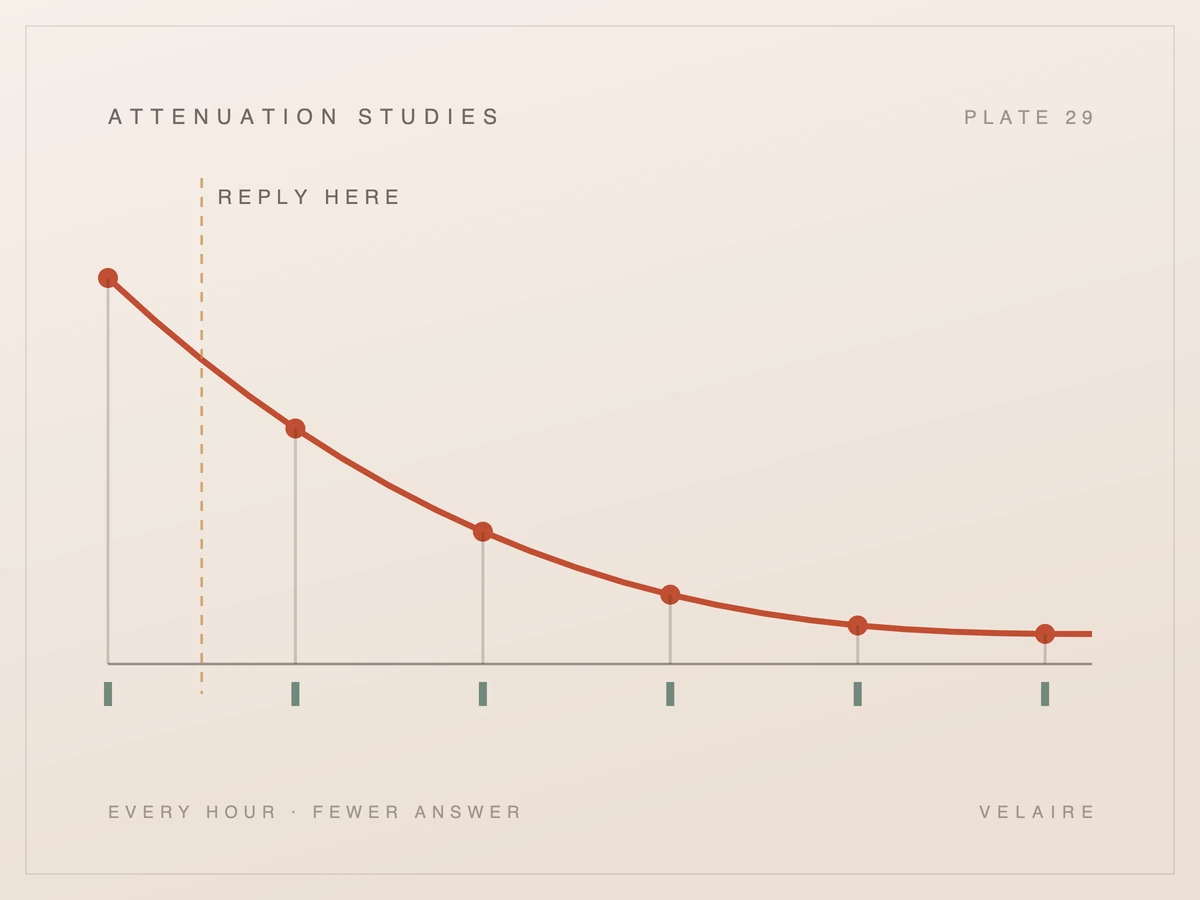
Response speed matters because interest is highest at the moment someone reaches out. A person who fills in a form or calls is often comparing options right then. Every hour of silence gives them time to call the next clinic, lose the thread, or decide to wait. Speed protects the intent you already paid to create.
Each inquiry comes from attention you paid for, in ad spend, content or years of reputation. Working out what one of those calls is worth to your own practice is a useful first step.
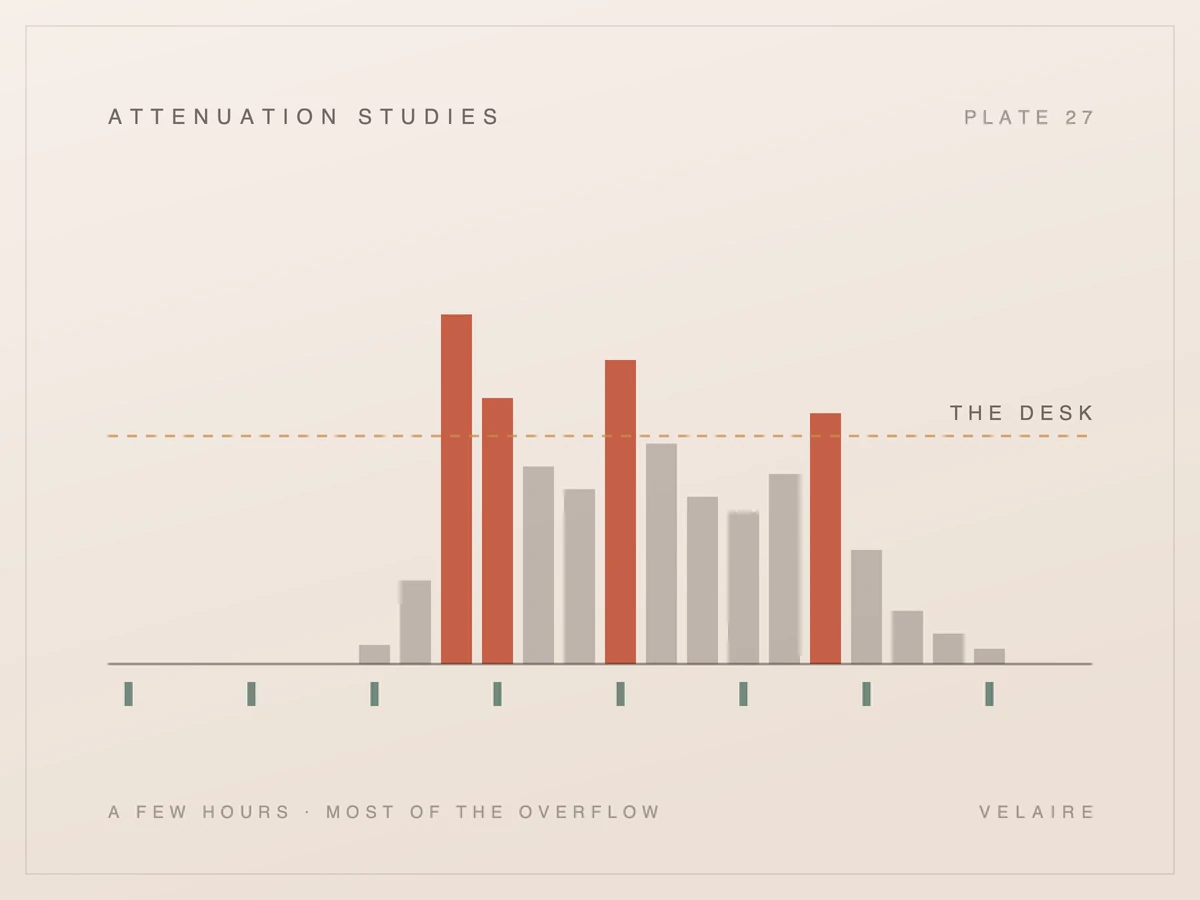
People reach out when they have time: evenings, lunch breaks, weekends. Those are often the hours the desk is closed, or when one person is checking in a client while answering the main line.
That is a structural problem, not a staffing failure. The desk rightly serves the people in the room first, so new inquiries become a pile for later, and later is where they cool off.
A slow reply rarely looks like a lost booking. It looks like a voicemail nobody returns and a form that quietly goes cold.
The research most often cited on this topic is a 2011 Harvard Business Review article about how quickly companies answer online sales leads. Its summary states plainly that most companies were not responding nearly fast enough. The full text sits behind a paywall, so this post relies only on what the public page says.
The article is "The Short Life of Online Sales Leads," published in the March 2011 issue by James B. Oldroyd, Kristina McElheran and David Elkington [1]. Its public summary says companies in financial services, automobiles, education, software, health care, professional services and many other industries had turned to the internet to generate sales leads, and that most were not responding nearly fast enough [1].
One detail is worth knowing: two authors are listed as business school professors, and the third, Elkington, as chairman and CEO of InsideSales.com [1]. Weigh that as you would for any study about sales follow-up.
Specific figures attributed to this article circulate widely online, usually hour-by-hour contact rates and large multipliers for fast responders. We could not open the full text while preparing this post, so none of them are repeated here, and neither are the popular few-minute reply rules.
What remains is the direction, and the title says it: online leads have a short life.
The research gives you a direction, not a med spa benchmark. It was about sales leads across many industries, it was not built around booked appointments, and it is now more than a decade old. It supports answering fast. It does not tell you what share of your own inquiries will book.
Four limits matter.
First, the industry mix. Health care appears in a long list of industries [1], and nothing on the public page breaks results out for clinics, let alone aesthetics. A person asking about a consultation may behave differently from a person asking about a loan or a software trial.
Second, the outcome. Reaching a person and having a useful conversation is only the first step. Booking, showing up and coming back are separate steps, and speed alone does not decide them.
Third, the age. The work was published in 2011, and people now compare clinics from one phone far more easily. That may make waiting riskier, but that is a judgment, not a measured result.
Fourth, cause and effect. Fast responders may be better run in other ways. Even a strong link between speed and contact would not prove that speed alone made the difference.
What carries over is the mechanism: a new med spa inquiry, like a sales lead, is a person with a question, often comparing a few options, who is easiest to reach right after they ask. We did not find a published, peer-reviewed study of response times at med spas specifically.
Treat a fast first reply as a line to stay under, not a promise of what speed will earn you.
A realistic target is to answer calls live, return any missed call within the hour during open hours, and make first contact on a web inquiry within the hour as well. Nothing should wait past the next business morning. These are working lines for a front desk, and they hold when someone clearly owns them.
The table below sets a target for each inquiry type. These are recommendations, not measured results: the 1-hour line is short enough to catch people while they are still deciding and long enough for a busy desk to meet.
| Inquiry type | Target for first contact | If the target is missed |
|---|---|---|
| Phone call during open hours | Answered live | Call back within 1 hour |
| Missed call or voicemail | Returned within 1 hour | Returned the same day, before close |
| Web form during open hours | First contact within 1 hour | Contact the same day, before close |
| Call or form after hours | Covered by an after-hours option | First call of the next business morning |
| Social message or chat | Reply within 1 hour during open hours | Reply the same day |
For live calls, the most useful outside yardstick comes from health care. A 2022 study of 6 Veterans Affairs medical centers chosen for above-average primary care access records the standard those sites worked to: an average speed of answer of 30 seconds or less and a call abandonment rate under 5% [2]. Those are daytime figures from staffed call centers, so read them as a ceiling on ambition for a small med spa, not a target.
A missed call becomes a callback, and the caller may already be dialing the next clinic. That is why it gets the same 1-hour target as a web form.
A web form is asynchronous: the person expects a reply, but not instantly. If they gave a number and agreed to be called, call first, and offer two specific open times. That gives them something concrete to say yes to, which an email asking when they are free does not.
Be strict about what counts as first contact. An autoreply that says "we got your message" is an acknowledgment, not an answer. Start the clock when the inquiry arrives and stop it at the first real attempt to talk, with a useful next step attached.
Ownership matters as much as the target. If "whoever is free" returns callbacks, nobody does during a busy hour. Name the person who owns new inquiries on each shift, and name who covers when that person is with a client.
After-hours inquiries are where the gap is widest. A form sent on Friday evening can sit until Monday if nobody covers it, which is far longer than any reasonable target. Your options are to staff later hours, use an answering service, or use an agent that answers and books the appointment itself.
A weekend inquiry left to voicemail misses the target by default, however quick your weekday team is. The table allows a fallback of the next business morning, and after a Friday evening inquiry, that morning is Monday.
Why evening and weekend calls behave so differently from daytime ones is covered in why after-hours calls are different.
Staffing later hours works, but it costs the most and still leaves overnight and holidays open.
An answering service puts a person on the line. Some take messages and some can book, so ask what yours does. If it takes messages, your morning starts with callbacks whose clocks ran all night.
A booking agent answers the call and books the appointment itself. Velaire Front Office answers calls 24/7, checks live availability, books into your practice calendar and texts the patient the time. Setup takes under 48 hours and needs no new hardware. Your morning then starts with booked slots to review, not a list of people to chase.
| Voicemail | Booking agent | |
|---|---|---|
| Who picks up | Nobody | Velaire Health, 24/7 |
| Books the appointment | No | Yes, into your calendar |
| Clinical or urgent questions | Wait for a callback | Routed to a person |
| Morning workload | Full callback list | Booked slots to review |
If your coverage plan for Saturday night is a voicemail greeting, your real response time for that inquiry is Monday.
Speed should never override judgment. Booking, rescheduling and availability questions suit a fast automated reply. Anything clinical, urgent or about a reaction after a treatment should go straight to a person on your team. A fast answer that gets a clinical question wrong is far worse than a slower, careful answer from your staff.
Velaire Health is built around that line. The agent never diagnoses and gives no medical advice. A caller with a clinical or urgent question is never booked; that call routes to a human on your team. Whether a treatment suits someone is a question for a qualified practitioner, not a booking call.
Write the handoff down: who receives routed calls during open hours, who is on call after hours, and what the caller hears while they wait. A handoff that only works when one particular person is in the building is not a plan.
Texting can shorten your response time, but in the US it needs the person's consent, and an opt-out has to be honored. Build to the strictest rule: once someone opts out, every message to that number stops. Canada adds its own consent rules under CASL. Check the current text of each rule before you switch texting on.
In the US, the FCC rule at 47 CFR § 64.1200 lets a person revoke consent to calls and texts by any reasonable method [3]. A reply of "stop," "quit," "end," "revoke," "opt out," "cancel" or "unsubscribe" counts as a valid revocation in itself, and a sender may not insist on one exclusive way to opt out [3]. The rule allows up to 10 business days to honor a revocation [3]. Do not plan around that ceiling. Set your system to stop at once.
The rule also allows one confirmation text after an opt-out, with no marketing in it, and one sent within 5 minutes is presumed to fall within the earlier consent [3]. If the person had agreed to several kinds of texts, that message may ask which they meant, but every text that needs consent stops until they answer [3]. The safe default is simple: one opt-out ends everything.
Timing matters too. The same rule bars telephone solicitations to residential lines before 8 a.m. or after 9 p.m., local time [3]. A person who just asked for a callback may fall outside its definition of a solicitation [3], but keeping callbacks and texts inside that window is still the safe habit.
These points reflect the rule text as checked on 15 October 2026. Consent and revocation rules have changed more than once, so confirm your wording with your own counsel. In Canada, CASL requires consent you can prove and an unsubscribe that works. Practices in Ireland and the UK work under their own rules, so do not copy US wording across.
Measure it by sending your own test inquiries and timing the reply. Then pull a week of missed calls and form submissions, note when each arrived and when someone first made contact, and look closely at the slowest cases. The slowest cases, not the average, show where inquiries go cold.
Submit a web form during open hours, then on a weekday evening and on a weekend, and time each first real reply. Call your main line after hours. Can a new caller book, or only leave a message?
Next, look at what already happened. Phone systems usually log missed calls with timestamps, and form tools record when a submission arrived. A spreadsheet with 3 columns (arrival time, first contact time, outcome) is enough.
The average can hide an inquiry that waited a whole weekend. Trace your 3 slowest cases: who was on shift, and where the handoff broke. Fix the handoff, not the person, and repeat the check monthly, since response time drifts when staff change or a campaign brings a spike.

Front office
Surveys show many customers distrust AI in service, mostly because they fear losing a route to a person. Waiting on hold also drives hang-ups. Here is how to weigh both risks.
Front office
Clinical and urgent calls are never booked by Velaire Health. They go to a person. Here is why that line exists, and how to write the handoff so an urgent caller never waits in a queue.
Front office
Voicemail looks like a safety net and behaves like an unmanaged work queue. Here is why the ownership problem is structural, what the alternatives actually change, and the number that settles it.
Front office
One is capturing discretionary demand that decides in the moment. The other is refilling a chair from a patient list it already owns. Same complaint, opposite problem, and the fix differs at every layer.
Front office
A missed call at 2pm and a missed call at 8pm are not the same problem. One is a delay you recover from. The other is usually just gone, and nobody is there to see it happen.
Operations
Vendor benchmarks disagree on when dental patients call. Here is how to read your own call log, map your peak hours by day, and see where the desk overflows.
The plain-language explainer: what it does, what it deliberately doesn't, and how it compares with voicemail, an answering service, a phone tree, and hiring.
See how Velaire would handle the calls your practice misses. A personal walkthrough, built around your questions.
Let’s talk about your practice