Front office
Will Patients Hang Up on an AI Phone Agent?
Surveys show many customers distrust AI in service, mostly because they fear losing a route to a person. Waiting on hold also drives hang-ups. Here is how to weigh both risks.
Clinical and urgent calls are never booked by Velaire Health. They go to a person. Here is why that line exists, and how to write the handoff so an urgent caller never waits in a queue.
A patient calls late at night and asks whether the swelling after yesterday's visit is normal. Whoever picks up that call should not be guessing, and neither should your phone agent.
After hours. The front desk is dark.
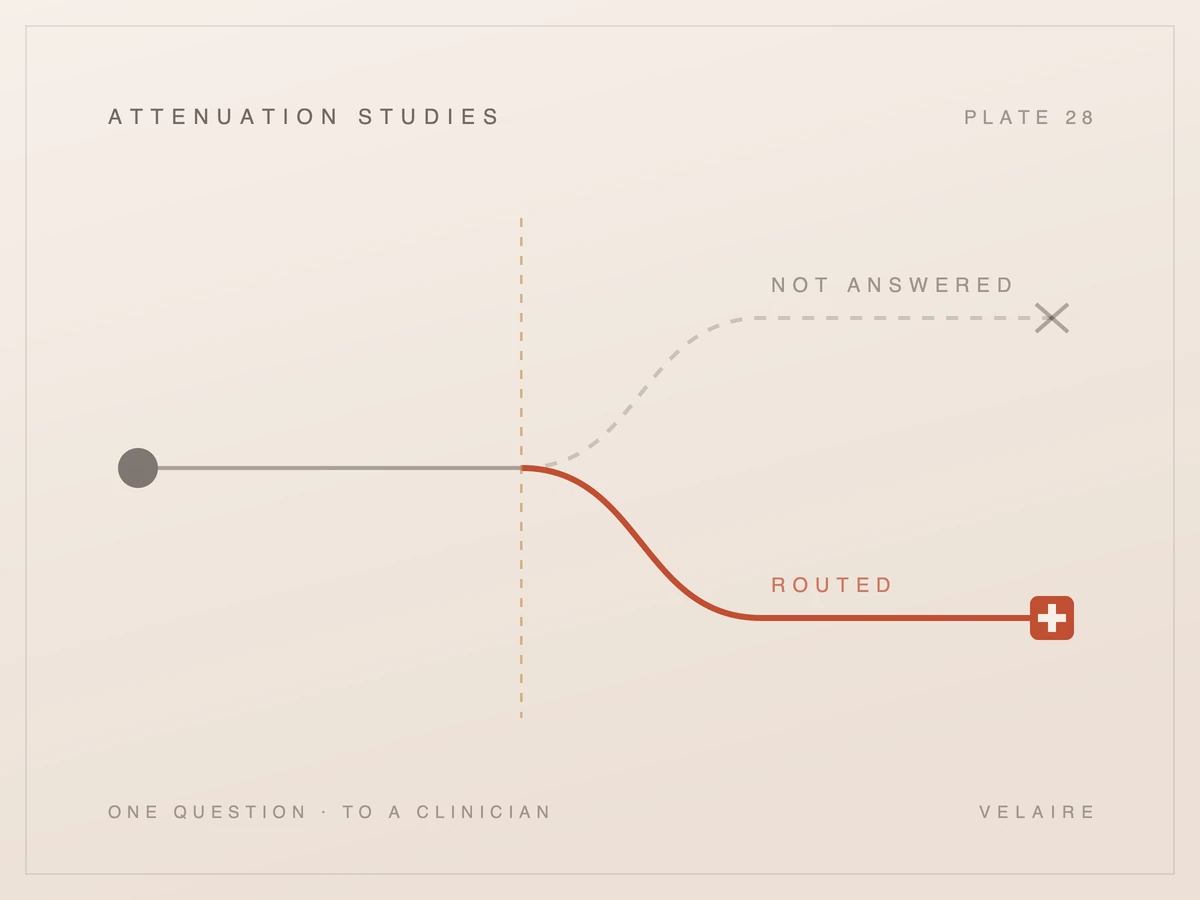
The agent does not answer that one.
A person picks up. The call is logged.
A caller who asks a clinical question needs a person, not a calendar slot. If your AI phone agent treats them like a booking, the most important call of the night ends with an appointment instead of a clinician. This post explains why Velaire Health never books those calls, and how you define the handoff so the person who needs help reaches someone fast.
A clinical call is a request for judgment, and judgment belongs to a licensed person. Booking the caller into next Tuesday can feel helpful, but it quietly tells them their question can wait. The agent cannot know that. So the call stops being a booking and goes to a person, every time.
Velaire Front Office does a narrow job. It answers calls 24/7, checks live availability, books into your practice calendar and texts the patient the time. That covers most of the routine traffic at a front desk: new bookings, reschedules, "do you have anything Thursday." It does not cover a caller who describes a symptom, a reaction after a visit, a question about medication or anything they call urgent.
Assessing a symptom over the phone is clinical work. The person on the line has to ask the right follow-up questions, weigh the answers and decide how soon the caller needs care. That takes training and judgment that belong to your clinical team, working to your practice's own standards.
That is the whole reason for the line. A booking agent is built to find a time and confirm it. It should not be the one deciding whether a symptom can wait.
Patients draw the line in the same place. In a 2024 Talkdesk survey of 1,000 US adults, 42% said they were comfortable with AI scheduling routine appointments, yet 81% still wanted a human for medical advice [1]. It is a vendor's survey, but the split matches this post: booking for the agent, judgment for a person.
The agent never diagnoses and never gives medical advice. Its job on a clinical call is to reach a person.
| The agent handles | A person handles | |
|---|---|---|
| The call itself | Answering the call, day or night | Any call where the agent is unsure |
| Availability | Checking live availability | Deciding how soon the caller needs care |
| Symptoms | Not answered, routed | Any question about symptoms or a reaction |
| Medication and aftercare | Not answered, routed | Any question about medication or aftercare |
| Urgency | Never booked as the answer | Anything the caller calls urgent |
| Booking | Booking into the calendar and texting the time | Any follow-up the clinician decides on |
A clinical call is any call where the caller wants to know something about their body, their treatment or their medication. An urgent call is any call where the caller says, or sounds like, it cannot wait. Your practice writes the list, in the words patients use, and the agent treats anything on it as a handoff.
The hard part is that patients rarely say "I have a clinical question." They say "is this normal," "it still hurts," "I think something's wrong," or "can I take my pills before I come in." A good trigger list is written in those words, not in clinical terms.
You do not need to copy a nursing protocol. You do need a written list of the words that move a call out of scheduling, owned by someone with clinical training.
For a med spa or aesthetics practice, typical triggers include:
For a dental practice, add pain, swelling of the face or jaw, a knocked-out or broken tooth, and bleeding after a procedure. Your clinical lead should own this list and sign off every phrase on it, not the front office and not the vendor.
The table below shows how common calls split.
| Call type | What the caller might say | What the agent does | Who owns it |
|---|---|---|---|
| Routine booking | "Do you have anything Thursday afternoon?" | Checks live availability, books, texts the time | The agent |
| Reschedule | "I need to move my appointment." | Finds a new slot, books, texts the time | The agent |
| Aftercare question | "Is it normal that it still looks swollen?" | Stops booking, routes to a person | Clinical team |
| Medication question | "Can I take my usual medication before I come in?" | Stops booking, routes to a person | Clinical team |
| Urgent or worsening | "It's getting worse and I'm worried." | Stops booking, routes on the urgent path | On-call clinician |
| Unclear | "I'm not sure if I need to come in." | Treats it as clinical, routes to a person | Clinical team |
On a live call, the handoff has four parts. The agent stops the booking flow, tells the caller it is getting them to a person, routes the call on the path you defined for that type, and records that it happened. No advice is given in between. If the first person does not answer, the backup runs.
The words the caller hears matter. A plain line such as "I'm connecting you with our clinical team now" tells them two things: the agent is not going to answer the question, and a person is. The caller should never have to argue their way to a human.
What the caller should not hear is a soft answer dressed as caution, such as "that's usually fine, but let me book you in." That sentence is advice, and it delays the person who should be listening.
Take a mixed call. A caller says, "I'd like to book my next visit, but first, is it normal that the area is still red?" The booking request is real, but the question comes first. The agent does not offer a slot and does not comment on the redness. It says it is connecting the caller with the clinical team and routes the call. Once a clinician has spoken with the caller, your team can book the next visit if it still makes sense.
There is one more case: the caller who describes something that sounds like an emergency. Your practice decides what the emergency message says, for example directing the caller to emergency services, and your medical lead approves the wording for each market you serve.
When in doubt, the agent treats the call as clinical. A routine call sent to a person costs a little staff time. The reverse can cost far more.
You define the handoff on one page your whole team can read. It names the trigger list, the person who takes clinical calls in business hours, the backup if they do not answer, the after-hours path and how each routed call is recorded. If any of those is missing, an urgent caller can end up waiting.
Start with the owner. During business hours, that is usually a nurse, a clinician or a trained lead who can take the call or call back fast. Name a person or a role, not "the team." A call routed to everyone is often answered by no one.
Then name the backup. People step away, take other calls or go home sick. Your handoff should say who is next and how long the first route rings before moving on. Agree ring times and callback targets inside the practice before anyone writes them on the page.
For a yardstick on speed, use one from somewhere with nothing to sell. A 2022 study of 6 Veterans Affairs medical centers chosen for above-average primary care access records the standard those sites worked to: an average speed of answer of 30 seconds or less, and a call abandonment rate under 5% [2]. Those are daytime targets for staffed call centers, so treat them as a ceiling on ambition rather than a promise any small practice can match.
After hours is where most practices find the gap. The agent covers the phone 24/7, but a clinical call still needs a person at the end of the route. That might be an on-call clinician, a nurse line or an answering arrangement you already use. Write down who it is for each night of the week, including weekends and holidays.
Last, decide how routed calls are recorded and who reviews them. A routed call that nobody looks at the next morning is a call nobody learns from.
Rules on AI in patient communication differ by state and country, and they change. Before go-live, ask your counsel whether patients must be told when AI is involved, whether they need a clear path to a human, and whether scheduling calls are treated differently from clinical messages where you operate.
This post does not summarize specific laws, because the details differ by market and change often. What it can do is give you the questions worth asking. Bring your one-page handoff definition to the conversation so your counsel can see exactly what the agent does and where it stops.
Patients care about disclosure too, and they care most where the task is clinical. Pew Research Center asked 3,488 US adults in June 2026 which uses of AI they wanted disclosed, and the answers tracked how clinical the task was: 81% for making a diagnosis, 80% for explaining lab results and 56% for scheduling an appointment [3]. Scheduling ranked lowest, but more than half still wanted it disclosed, so do not assume a booking call needs no disclosure at all.
Start with these:
None of this is legal advice. Treat it as a reason to put the question to your counsel.
A written handoff is what makes the routing rule reliable. Without it, the agent knows to send clinical calls to a person but has nowhere specific to send them. With it, every clinical caller follows a path your clinical lead has approved, staffed and tested. The agent follows the plan; it does not replace it.
Clinical teams already work from written standards for the care they give in person. Phone calls deserve the same treatment. A page that names the trigger list, the owner, the backup and the after-hours path turns a good intention into something your staff can follow on a busy Monday or a quiet Saturday night.
A written handoff also protects your staff. When a call goes wrong, "the agent should have known" is not a policy. "Here is the trigger list, the owner, the backup and the log" is.
It helps the patient as well. A caller who reaches a person on the first try trusts the practice more than one who was booked, sent a text and left to wonder. For why the evening hours behave differently from the rest of the day, see why after-hours calls are different.
You test the handoff the way a patient would use it: by calling. Before launch, staff place scripted calls using the phrases on your trigger list, plus vague ones, and check that each reaches the right person, that the backup runs when nobody answers, and that every routed call leaves a record.
Write a short test sheet. Include clear clinical phrases, mixed calls ("I want to book, but first, is this normal?") and vague ones ("I'm just not sure"). Mixed calls are the ones most likely to slip through, because the caller asks for a booking in the same breath.
Run the tests in business hours and after hours. The after-hours route is often the one nobody has tried. Test what happens when the owner does not pick up, and watch the backup run.
After launch, keep reviewing. Pick a fixed day each week to look at routed calls, check that each one reached a person, and add any new phrases to the trigger list. If your line is covered by an answering service today, this comparison sets out what changes when the call can be booked on the spot.

Front office
Surveys show many customers distrust AI in service, mostly because they fear losing a route to a person. Waiting on hold also drives hang-ups. Here is how to weigh both risks.
Front office
What published research can and cannot tell you about replying to new inquiries, and a target your front desk can hold for live calls, callbacks and web forms.
Front office
Voicemail looks like a safety net and behaves like an unmanaged work queue. Here is why the ownership problem is structural, what the alternatives actually change, and the number that settles it.
Front office
One is capturing discretionary demand that decides in the moment. The other is refilling a chair from a patient list it already owns. Same complaint, opposite problem, and the fix differs at every layer.
Front office
A missed call at 2pm and a missed call at 8pm are not the same problem. One is a delay you recover from. The other is usually just gone, and nobody is there to see it happen.
Operations
Vendor benchmarks disagree on when dental patients call. Here is how to read your own call log, map your peak hours by day, and see where the desk overflows.
The plain-language explainer: what it does, what it deliberately doesn't, and how it compares with voicemail, an answering service, a phone tree, and hiring.
See how Velaire would handle the calls your practice misses. A personal walkthrough, built around your questions.
Let’s talk about your practice