Front office
Voicemail Is a Queue Nobody Owns
Voicemail looks like a safety net and behaves like an unmanaged work queue. Here is why the ownership problem is structural, what the alternatives actually change, and the number that settles it.
A missed call at 2pm and a missed call at 8pm are not the same problem. One is a delay you recover from. The other is usually just gone, and nobody is there to see it happen.
Your phone system reports one number for missed calls. It does not sort them by whether anybody could realistically have answered, which is the only sorting that changes what you do next.
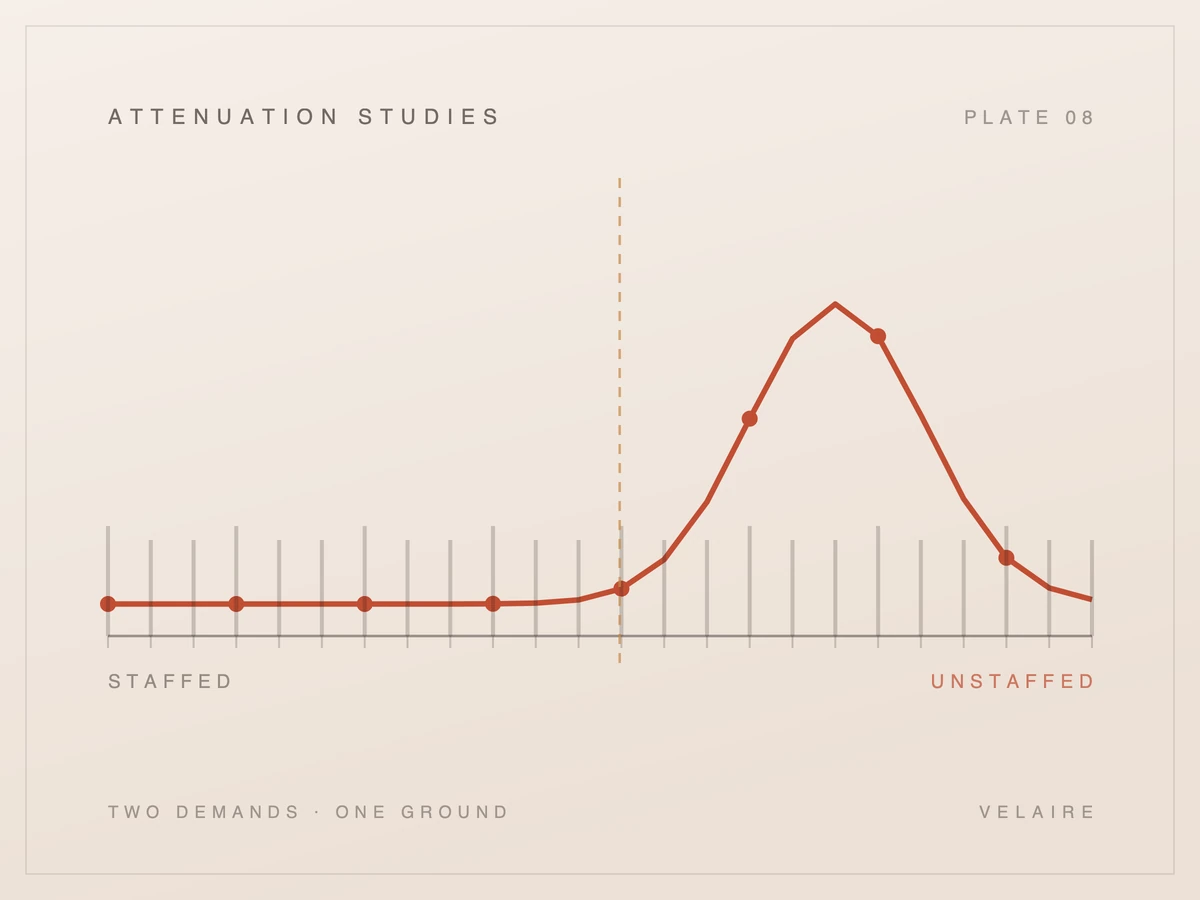
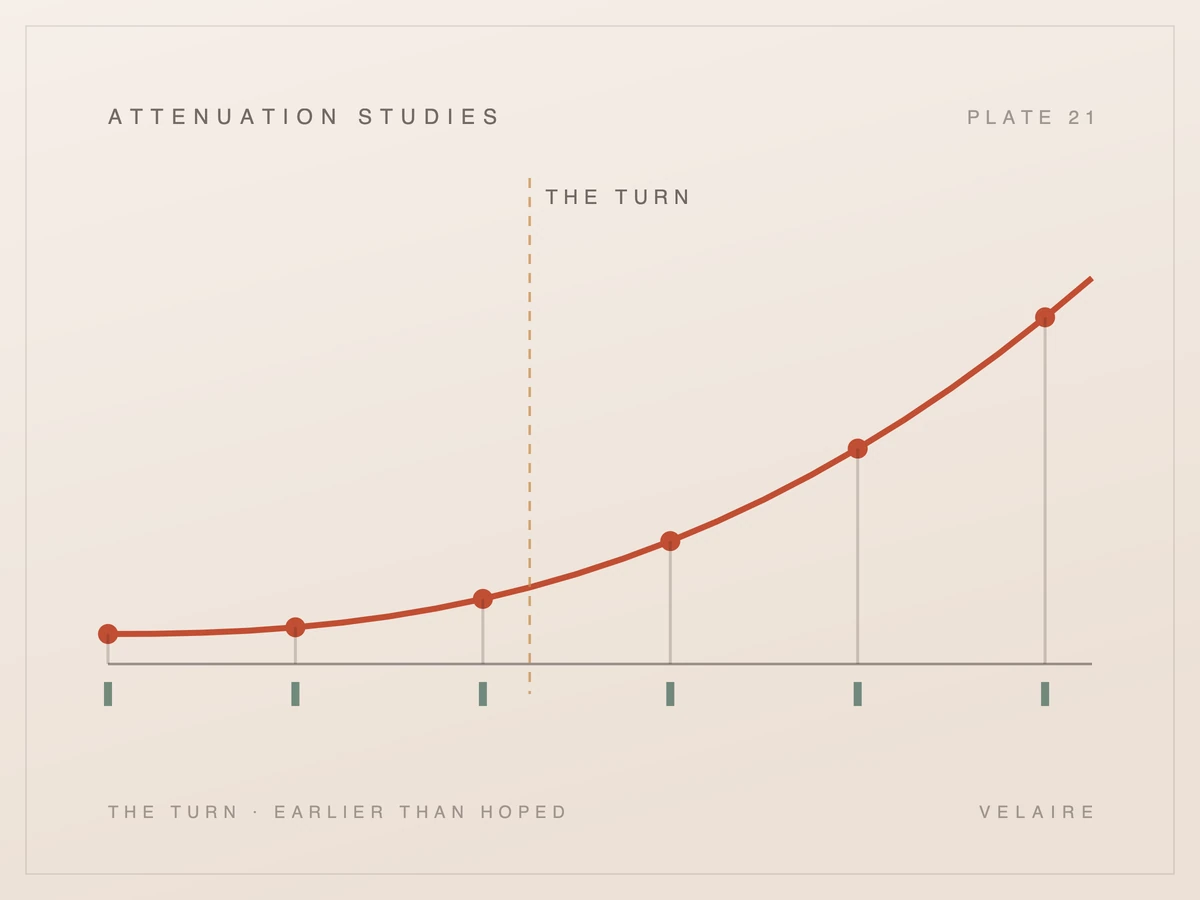
a call missed at 2pm
a call missed at 8pm
the building, at 8pm
Most practices treat a missed call as one category of problem. The phone rang, nobody picked up, someone will deal with it tomorrow. That framing is comfortable and it hides the thing that actually matters, which is that the same event has very different consequences depending on what time it happened.
A call missed at 2pm and a call missed at 8pm are not the same problem wearing different clothes. One of them usually recovers on its own. The other usually does not, and because it happens when the building is empty, nobody is there to notice it happening at all. This is about why that gap behaves the way it does, and how to size yours before deciding whether it is worth closing.
A daytime call that goes unanswered usually gets a second chance. The phone rings again, or the caller tries the front desk tomorrow morning. A call that lands after close often gets no second attempt at all, because the person calling has other options in front of them and no particular reason to wait around for you.
That is the whole difference in one sentence, and it changes what each miss costs. A daytime miss is a delay: the work moves to later today or first thing tomorrow, and the relationship survives it intact. An after-hours miss is a decision point you were not present for.
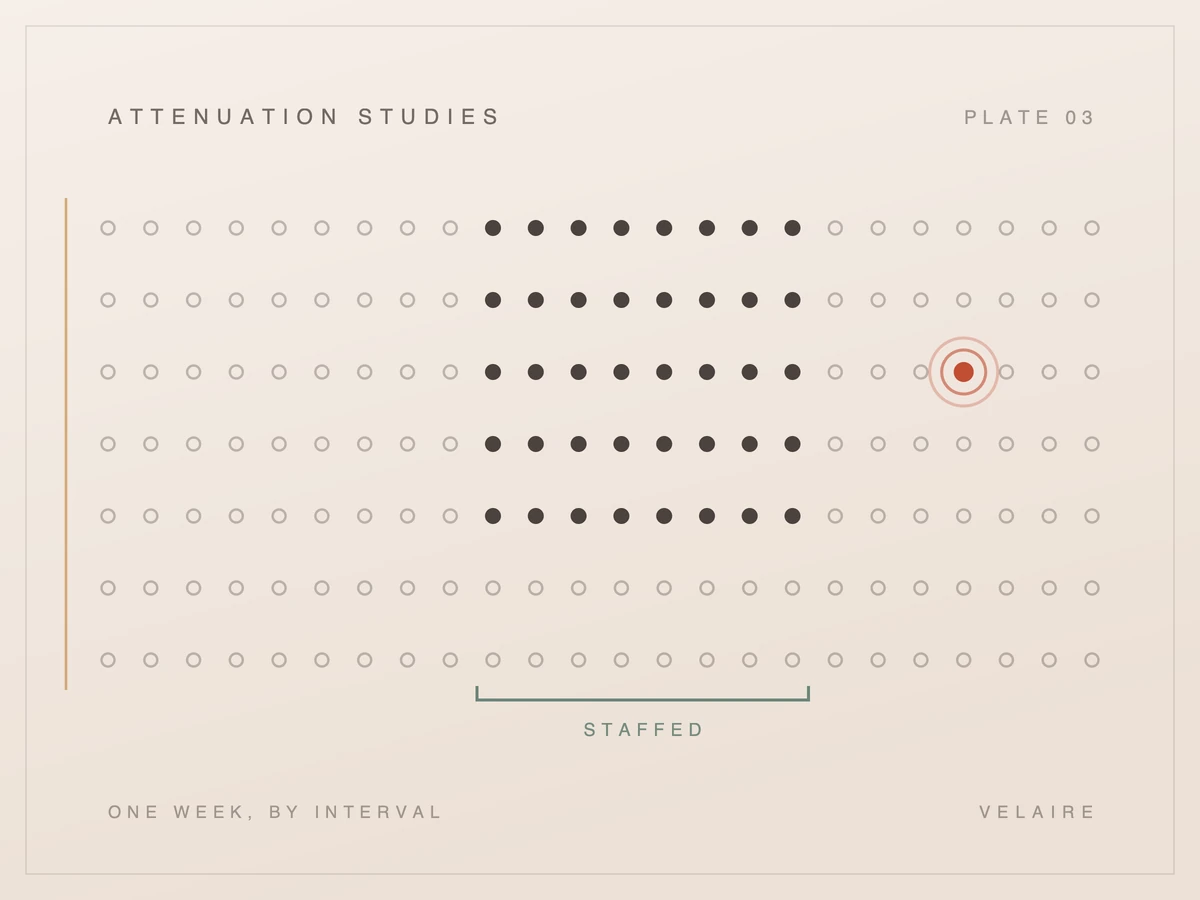
The arithmetic underneath is unforgiving. A week has 168 hours. A practice open 8 hours a day, 5 days a week, is staffed for 40 of them. The remaining 128 hours are not a quiet edge case around the margins of the business. They are the majority of the week, and calls keep arriving through all of them.
A daytime miss is a delay. An after-hours miss is often just gone.
Most practices have never looked at the split this way, because the phone system reports one number for missed calls and does not sort it by whether anybody could realistically have answered. The 40 hours get scrutinised constantly, since that is where staff, rotas and cost all live. The 128 hours get no attention at all, because there is nothing there to manage.
It is worth noticing that the ratio gets worse, not better, as a practice grows. Extending to Saturday mornings or a late evening clinic adds a few staffed hours and does nothing meaningful to the shape of the week. Coverage is not a scheduling problem you can gradually solve by opening longer.
Someone calling about an elective, appearance-driven treatment is rarely calling because they have to. They are calling because they decided, in that particular moment, that they wanted to look into it. That decision has a short half-life, and it does not pause politely until Monday morning.
This is what separates elective practices from urgent ones. A patient with a genuine medical problem will call back, because the problem is still there in the morning. Someone who spent an evening thinking about a consultation is in a different state entirely, and by 9am the impulse may have passed or landed somewhere else.
There is a second-order effect worth naming. The people most likely to call in the evening are often the ones least likely to have called at all during the day, because daytime calling means finding privacy at work or explaining themselves in a room with other people in it. Evening callers are frequently your least-committed, most-nervous prospects, which is exactly the group a callback recovers worst.
The uncomfortable implication is that your recovery rate on these calls is not really a measure of how good your callbacks are. You can have an excellent front desk making prompt, friendly callbacks at 9:15 the next morning and still lose most of them, because the callback is arguing with a decision that was already made without you in the room.
When a call is not answered, the caller does something next, and it is worth being specific about what. They try the next practice on the list, they book online somewhere that offers it, or they put the whole thing down and do nothing at all. Only one of those three outcomes leaves your door open.
The vague version of this claim is where most vendor marketing lives, usually attached to a dramatic percentage. The specific version is more useful and less alarming: you are not losing every missed caller, you are losing the share of them who had somewhere else to go that evening.
There is a published benchmark for how much of this should be happening at all. A study of 6 Veterans Affairs medical centres chosen for above-average primary care access, published in 2022, records the standard those sites were held to: an average speed of answer of 30 seconds or less, and a call abandonment rate under 5% [2]. Those are daytime numbers from staffed call centres working to a mandate, so read them as a ceiling on ambition rather than a target for a small practice at 8pm. They remain the most useful yardstick available, because they come from somewhere with nothing to sell you.
Patient behaviour here has shifted in a way that works against practices relying on callbacks. In a 2024 Talkdesk survey of 1,000 US adults, 42% said they were comfortable with AI scheduling routine appointments outright. Among patients dealing with sensitive health issues, 67% said they would be more comfortable booking through an online chatbot than with a person [1].
Both numbers describe a population that is more comfortable with automated booking than the objection usually assumes. That second figure deserves a second read if your practice is in aesthetics or anything elective. A meaningful share of your first-time callers may actively prefer not to explain themselves to a receptionist, which means the after-hours channel is not simply a fallback for them. It is the channel they would have picked anyway.
None of this means patients want automation everywhere. The same survey found 81% still wanted a human for actual medical advice [1]. The line they draw is consistent and sensible: administration is fine, clinical judgement is not, and any system covering your phone has to respect that split rather than pretend it does not exist.
Independent polling finds that line drawn in the same place. Pew Research Center asked 3,488 US adults in June 2026 which uses of AI they wanted disclosed, and the answers tracked how clinical the task was: 81% for making a diagnosis, 80% for explaining lab results, and 56% for scheduling an appointment [3]. Scheduling is the task people care least about, which is exactly the one an after-hours system should be doing.
The obvious fix is to have somebody there. It is also the one almost nobody does, because staffing a phone line at 9pm on a Tuesday is not a reasonable ask, and the call volume rarely justifies a salary even when the lost revenue would.
The economics are awkward in a specific way. After-hours volume is low per hour but spread thinly across a great many hours, so you cannot solve it with a shift. You would be paying somebody to be available across 128 hours a week to handle a number of calls that might comfortably fit inside one afternoon.
The problem is not that those hours are hard to staff. It is that they are impossible to staff efficiently.
Rotating the duty across existing staff sounds cheaper and tends to go badly. Someone is nominally on call, the phone diverts to a personal mobile, and within a month the arrangement has quietly degraded into voicemail with extra steps. It also puts a member of your team on an unpaid tether every evening, which is a real cost even when it does not appear on a payroll line.
Answering services exist for exactly this reason, and they solve roughly half of it. A human picks up and takes a message, which is better than voicemail. It still hands you a callback to make tomorrow, which is the part that works poorly for elective enquiries. Closing the gap properly needs something that can complete the booking on the call itself, which is a different category of product worth understanding before you shop for either one.
Before deciding whether any of this is worth paying for, get your own figure. Almost every phone system logs missed calls with timestamps, and that log will tell you more about your practice in twenty minutes than any vendor statistic ever will. The number is rarely what people guess.
What you are looking for is not the total. It is the after-hours subset, and specifically how many of those callers never appear again in any form: no answered callback, no booking, no trace of them anywhere in the following weeks. That is your actual leak, and it is the only number that should drive the decision.
The table below is the shape of what changes, depending on which of three situations a given call lands in.
| Call scenario | During business hours | After hours, no coverage | After hours, with coverage |
|---|---|---|---|
| Someone available to answer | Usually | No | Yes, automatically |
| Call gets answered | Usually | Rarely | Every time |
| Typical outcome if missed | Callback within hours | Caller goes elsewhere | Appointment booked |
| Work left for tomorrow | Some | A callback that may not land | None |
Once you have your own number the comparison becomes concrete instead of theoretical. Work out what one of those calls is worth to your practice, multiply it out, and hold the result against the cost of covering the hours.
A call log is the best evidence available and it is still incomplete. It records calls that reached your system, which is not the same as every person who tried to reach you. Knowing where the gaps sit stops you from treating one imperfect number as the whole picture.
Three things routinely go missing. Callers who hang up during the first ring often do not register as calls at all, depending on the system. Calls that divert to a personal mobile leave no trace in the practice log. And anyone who checked your opening hours online and decided not to bother dialling never appears anywhere, which is a genuinely invisible category.
The call log understates the problem. It never overstates it.
That asymmetry is useful, because it means whatever number you pull is a floor rather than an estimate. If the floor already justifies the cost of covering the hours, you do not need to argue about the parts you cannot measure. If it does not, you have an honest answer and you can stop looking.
One thing worth checking while you are in there: how many after-hours callers ring more than once in the same evening. Repeat dialling within a few minutes is a strong signal of intent, and those are the callers a practice can least afford to leave with a voicemail greeting.
Coverage does not make a practice busier and it does not improve anything happening during the day. What it changes is narrow and specific: calls arriving in those 128 hours get answered and, where appropriate, turned into a booking request rather than a message for somebody to chase.
There is also a reporting side effect that practices tend to value more than they expected to. Once something answers every after-hours call, the volume becomes visible for the first time, and the guesswork this whole post is about stops being necessary. You get a real monthly count rather than an inference drawn from silence.
Being precise about that boundary matters, because it is where expectations usually go wrong. If your daytime phone rings out because two people are covering four jobs, evening coverage does not touch that problem at all. Overflow coverage during business hours is a separate decision, priced separately, and worth naming now rather than discovering later.
The entry plan, Recovery, covers after-hours calls at $599 a month, runs on the number your practice already publishes, and takes under 48 hours to go live with no new hardware. Whether that is worth paying depends entirely on the number you pulled out of your own call log, which remains the only honest way to answer the question.

Front office
Voicemail looks like a safety net and behaves like an unmanaged work queue. Here is why the ownership problem is structural, what the alternatives actually change, and the number that settles it.
Front office
One is capturing discretionary demand that decides in the moment. The other is refilling a chair from a patient list it already owns. Same complaint, opposite problem, and the fix differs at every layer.
Buyer's guide
Seven lessons scoring five options, including doing nothing, against your own after-hours data. Ends with a written decision, a review date, and a clear reason if the answer turns out to be no.
Operations
Seven lessons of unglamorous cleanup that decide whether a connected system works. Appointment types, availability rules, duplicates, phone formats, and who is allowed to write what.
Compliance
Six situations that happen weekly at every practice, what the rule actually permits in each, and why the answer is usually more permissive than staff assume and stricter than callers expect.
Operations
Seven lessons on the misses that happen while you are open and staffed. Find the abandonment curve, match volume to cover, fix the hold experience, and give callers a way out that is not hanging up.
The plain-language explainer: what it does, what it deliberately doesn't, and how it compares with voicemail, an answering service, a phone tree, and hiring.
See how Velaire would handle the calls your practice misses. A personal walkthrough, built around your questions.
Let’s talk about your practice