No-Show Rates: What the Evidence Actually Supports
Reminders work. They work less dramatically than the marketing suggests, and the honest number is a 10.8 point improvement rather than the 14.6 point one everybody quotes. Here is what the trials found.
+ Pooled evidence puts attendance at 67.8% with no reminder and 78.6% with a text, about 10.8 percentage points.
+ Text and telephone reminders perform the same on attendance, and text costs 55% to 65% less per attendance.
+ The widely quoted 14.6 point figure comes from 169 patients at one clinic whose control group missed 38.1% of appointments.
+ The Cochrane authors state the evidence is still insufficient to conclusively inform policy decisions.
+ Reminders treat forgetting, so your ceiling is set by how much of your no-show rate is actually forgetting.
The reminder statistic in every vendor deck traces back to a real study. It is usually a study of 169 children at one Medicaid clinic, and the authors said in writing that it does not generalise.
the sales deck
the study, page 7
The number is real. The sentence the authors wrote underneath it usually is not quoted.
Every product that sends appointment reminders arrives with a statistic. The statistic is usually real, usually from a peer-reviewed trial, and usually stripped of the two or three sentences that tell you who it applied to. The result is a category where the evidence is genuinely good and the marketing is genuinely misleading, which is an unusual combination and worth untangling.
The underlying literature is better than most healthcare software has behind it. There is a Cochrane systematic review, there are randomised controlled trials with thousands of participants, and the direction of the finding is consistent. What the literature does not support is the size of the effect that gets quoted, or the confidence with which it gets quoted.
This is a summary of what the trials found, what the researchers themselves said about applying it elsewhere, and what a practice should reasonably expect. It ends somewhere useful rather than somewhere cynical: reminders work, and you should probably send them.
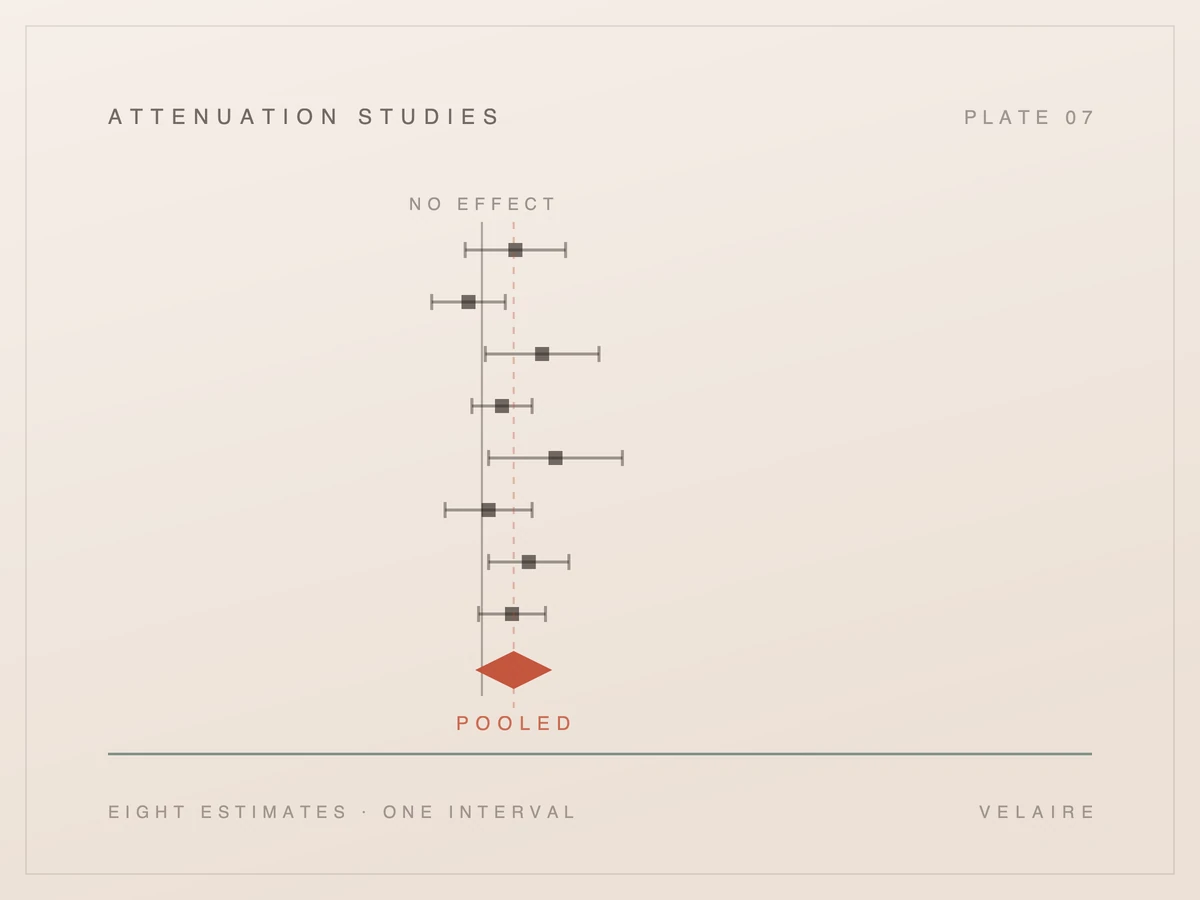
The best single source is a Cochrane systematic review of mobile phone messaging reminders, which pooled 8 randomised controlled trials covering 6,615 participants. Pooling matters here, because any individual trial is a study of one clinic's population and the review is an attempt to say something across all of them.
Against no reminder at all, text reminders improved attendance with a risk ratio of 1.14, with a 95% confidence interval from 1.03 to 1.26, drawn from 7 studies and 5,841 participants and rated moderate quality [1]. A risk ratio of 1.14 means attendance was 14% better in relative terms, which is not the same claim as 14 percentage points and is routinely presented as though it were.
The absolute numbers in the review are more useful than the ratio. Across the pooled studies, attendance was 67.8% with no reminder, 78.6% with a text reminder, and 80.3% with a phone call [1]. That is a real improvement of about 10.8 percentage points from texting, and it is the number a practice should plan against.
A risk ratio of 1.14 is not 14 percentage points. The gap between those two readings is most of this category's marketing.
The second finding has the clearest operational consequence, and it is the one least often quoted because it does not favour anybody's product in particular. Text reminders and telephone reminders produce statistically indistinguishable attendance rates, which means the choice between them is a cost decision rather than a clinical one.
The review found a risk ratio of 0.99 comparing text against phone calls, with a confidence interval from 0.95 to 1.02 across 3 studies and 2,509 participants [1]. A confidence interval that comfortably spans 1.0 is the statistical way of saying there is no detectable difference between the two.
A large single trial reached the same conclusion independently. A non-inferiority randomised trial at Geneva University Hospitals enrolled 6,450 patients, randomising 3,285 to a text reminder and 3,165 to a telephone call 24 hours before the appointment. Missed appointments ran at 11.7% for text and 10.2% for telephone, a difference that did not reach significance at p equal to 0.07 [2].
Attendance across the pooled trials
No reminder67.8%
Text reminder78.6%
Phone call80.3%
Cochrane review, 8 trials, 6,615 participants. Text and phone land in the same place.
Where they differ is cost, and the difference is large. Two studies in the Cochrane review found the cost per text per attendance was 55% and 65% lower than the equivalent phone call [1]. The Geneva trial reached the same conclusion, reporting that only the text reminder was cost-effective despite the two performing similarly on attendance [2].
The practical reading is that if you are currently making reminder calls by hand, the evidence supports switching to text on cost grounds and does not support expecting better attendance from doing so. That is a real saving and a modest one, and it is worth being clear about which is which.
There is a staffing consequence hiding in that, and it is larger than the messaging cost. A practice making 60 reminder calls a day at 90 seconds each is spending roughly 90 minutes of front-desk time daily on a task the evidence says a text does equally well. Whether that 90 minutes is worth more spent elsewhere is a practice-specific question, but it is the actual saving, and it does not appear in any per-message price comparison.
One caveat on the Geneva trial before moving on. Its reminders went out 24 hours before the appointment, which is the interval most of the literature uses. The trials do not establish that 24 hours is optimal, and a practice with a 6 week booking horizon may reasonably want a second touch earlier. That is an untested variation rather than a supported one.
The figure that appears most often in marketing is a 14.6 percentage point reduction in no-shows. It is real, it comes from a properly conducted randomised controlled trial, and the trial is much smaller and much more specific than its use implies.
That study enrolled 169 patients at an urban paediatric resident clinic in an academic medical centre, randomising 85 to receive a text alongside the usual voice message and 84 to the voice message alone. No-shows ran at 23.5% in the intervention group against 38.1% in the control, a 14.6 point difference at p equal to 0.04 [3].
Those are good results and the authors were careful about them. They wrote explicitly that the results apply to similar populations and may not generalise to other populations or clinics with different demographics, noting the clinic served mostly Medicaid patients and that resident scheduling skewed toward infants and toddlers requiring frequent visits [3].
The trial behind the famous number
169
patients enrolled
85 intervention, 84 control
38.1%
no-show rate in the control group
a very high baseline to improve on
14.6
point absolute difference
p equal to 0.04
Real, well conducted, and specific. The authors said so themselves.
A control group missing 38.1% of its appointments is the important detail. That is a very high baseline, and interventions applied to very high baselines have more room to move than the same intervention applied to a practice already running at 8%. A med spa with a 6% no-show rate cannot recover 14.6 points, because it does not have 14.6 points to recover.
The sample size matters too, in a way that is easy to wave away. At 169 patients split into 2 arms, a handful of appointments moving either way shifts the headline figure by several points. The p value of 0.04 says the result is unlikely to be chance, and it does not say the effect size is precisely 14.6 points. Small trials are noisier about magnitude than they are about direction, which is exactly why the pooled review exists.
None of this is a criticism of the study. It is a well conducted trial that says what it says, and the authors flagged the limits themselves. The problem is entirely downstream, in the gap between a paper that says "in this population" and a slide that does not.
The Cochrane authors' own conclusion is more cautious than anything a vendor will tell you, and it comes from the people who read all 8 trials rather than the one that suited them. Their summary is that the evidence remains insufficient to conclusively inform policy decisions. That is a striking sentence to end a review that found a real effect.
The citation for that is the same review quoted throughout this piece [1], and it is worth reading the conclusion section rather than the abstract, because the caution lives there.
They give specific reasons. The included studies were heterogeneous, the quality of evidence ranged from low to moderate, and the trials measured attendance without measuring health outcomes, adverse effects, or how patients felt about being messaged. A review that finds an effect and then says the evidence is not yet sufficient for policy is being honest about the difference between a signal and a settled question.
That does not mean do nothing. It means the correct posture is that reminders are cheap, well tolerated, and probably help by roughly 10 percentage points, rather than that reminders are a proven intervention with a known effect size at your practice.
The review that found the effect also said the evidence is insufficient to conclusively inform policy. Both things are true.
Patient tolerance, at least, looks solid. In the Geneva trial's satisfaction survey no patient reported being disturbed by either type of reminder, and three quarters of those surveyed recommended implementing them routinely [2]. That is a low-risk intervention by any reasonable reading.
Start from your own baseline, because the baseline determines the ceiling. Pull your no-show rate for the last 3 months from your practice management system before reading any vendor's number, and you will immediately know whether their claimed improvement is arithmetically available to you.
A practice at 25% has room for a substantial absolute improvement and should expect something in the region the pooled evidence suggests. A practice at 7% is already near the floor for its population, and most of what remains is not forgetfulness, which is the only thing a reminder addresses.
That last distinction is the one to hold onto. Reminders treat forgetting. They do not treat a patient who cannot get childcare, cannot leave work, has decided against the treatment, or never intended to come. The literature is a literature about forgetting, and the share of your no-shows that are forgetting is a practice-specific number nobody else can tell you.
You can estimate it cheaply, and it takes about 2 weeks. Have whoever rebooks a no-show ask one question and write the answer in a spreadsheet: what stopped you coming in. Categorise the answers into forgot, could not, and changed my mind. Practices that do this are often surprised by how small the forgot column is, and that column is the only one a reminder addresses.
The exercise has a second benefit. The could not column frequently points at something a practice can genuinely fix, such as appointment times that assume nobody works, and that fix is usually cheaper than any software.
What a reminder can and cannot fix
A reminder helps
The patient forgot the date
The patient forgot the time
The appointment was booked 6 weeks ago
The patient needs a prompt to rearrange rather than skip
A reminder does nothing
Childcare or transport fell through
The patient cannot leave work
The patient decided against the treatment
The patient never intended to attend
The literature is a literature about forgetting. Everything else is a different problem.
One more baseline is worth pulling while you are in the system: your no-show rate split by how far ahead the appointment was booked. A visit booked 2 days out and one booked 8 weeks out are different risks, and if your misses concentrate in the long-horizon bookings then forgetting really is your problem and reminders really will help. If they are spread evenly, something else is going on.
The honest expectation, then, is a real improvement of several percentage points, larger if your baseline is high, achieved with a cheap intervention that patients do not object to. That is worth doing. It is not a transformation, and a vendor promising one is quoting a paediatric Medicaid clinic at you without mentioning it.
If you want to work out what your own gap is worth before deciding what to spend on it, size your missed-call gap walks the same evidence-first approach through your own call records. The related question of what the front desk costs in the first place is worked through in what a front desk actually costs.
FAQs
Questions about this
No, and the difference is large. A risk ratio of 1.14 means attendance was 14% higher in relative terms. In absolute terms the pooled trials moved attendance from 67.8% to 78.6%, which is about 10.8 percentage points. Vendors frequently present the relative figure as though it were the absolute one.
Text instead of calling to reduce cost, not to reduce no-shows. Both the Cochrane pooling and a 6,450-patient trial in Geneva found no meaningful difference in attendance between the two. What the evidence does support is that texting costs substantially less per attendance, which is a real reason to switch.
Less than the marketing implies. The large published effects come from settings with very high baselines, including one control group missing 38.1% of appointments. At 6% you are close to the floor for most populations, and the remaining misses are likelier to be circumstance or intent than forgetfulness, which reminders do not address.
The available evidence says no. In the Geneva trial's satisfaction survey, no patient reported being disturbed by either a text or a telephone reminder, and roughly three quarters of those surveyed recommended implementing reminders routinely. That is one clinic and one survey, but it is the direction every related study points in.
Because the intervention is cheap, patients tolerate it, and the effect is consistently positive across 8 trials even if its size is uncertain. Moderate quality evidence for a low-cost, low-risk intervention is a reasonable basis for acting. It is not a reasonable basis for a vendor quoting a precise percentage at you.
Builds AI front-office systems for medical and aesthetic practices. Posts here start from published sources rather than vendor claims, and every number links back to where it came from.
Eligibility checks, prior authorisations and claim status inquiries have measured per-transaction costs. Automating your phone does not touch any of them, and it is worth knowing that before you buy.
The patients most likely to book are the ones you have already treated. Here is why the contact rate is the number that matters, why recall is not marketing under HIPAA, and why the list decays quietly.
The salary is the number everyone quotes and the easiest one to find. Three others sit underneath it, and together they change what any coverage decision is really being compared against.
Nine lessons that turn one month of call records into a defensible range for what your missed calls are costing. No new software, no vendor stat sheets, and an honest answer at the end even if it is small.
Skip the vendor stat sheets. Four numbers you already have will tell you what a missed call is worth to your specific practice, and whether covering them is worth paying for.
Surveys show many customers distrust AI in service, mostly because they fear losing a route to a person. Waiting on hold also drives hang-ups. Here is how to weigh both risks.
The plain-language explainer: what it does, what it deliberately doesn't, and how it compares with voicemail, an answering service, a phone tree, and hiring.