What a Front Desk Actually Costs, Beyond the Salary
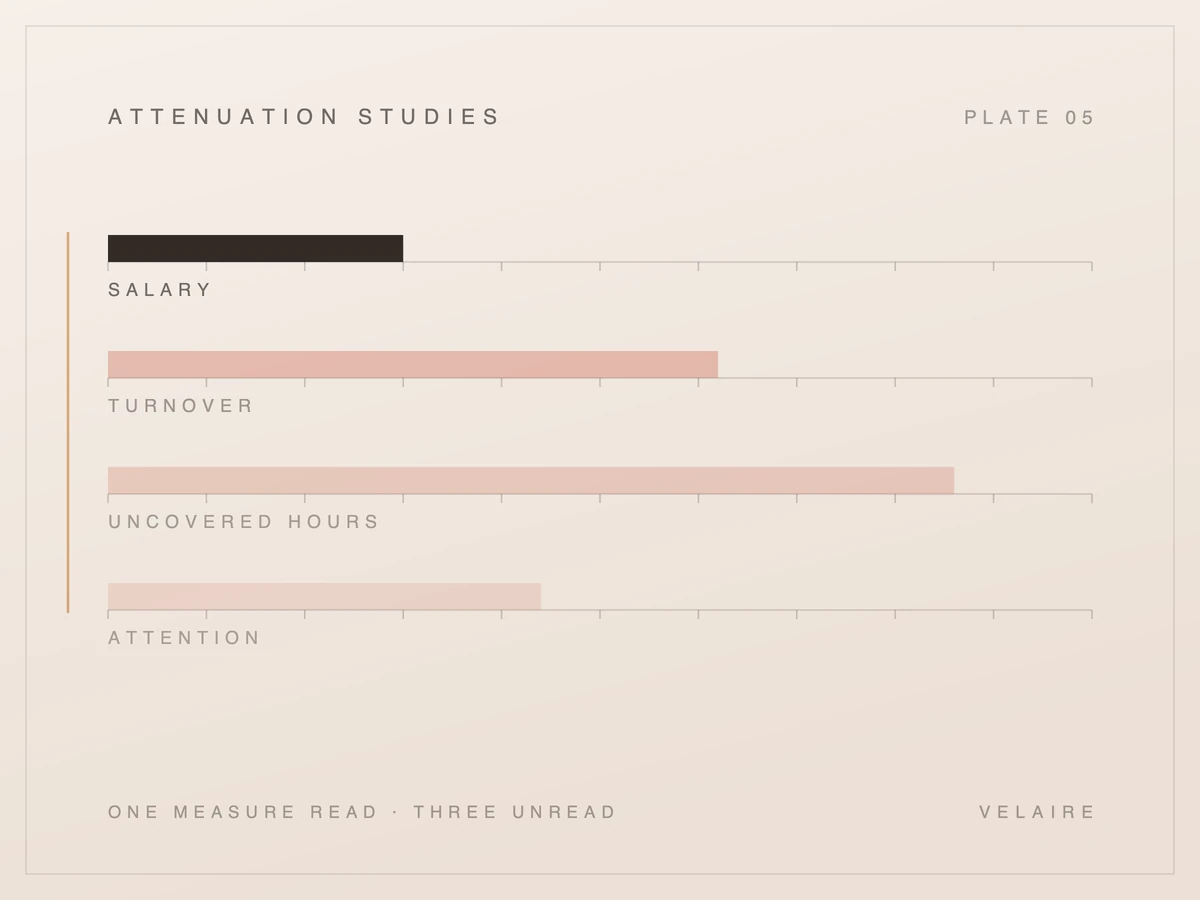
The salary is the number everyone quotes and the easiest one to find. Three others sit underneath it, and together they change what any coverage decision is really being compared against.
+ Salary is the only one of the four front-desk costs that does not rise when the phone gets busier.
+ Turnover is the largest swing between two otherwise similar practices, and most owners have never costed their own vacancy months.
+ A standard week leaves 128 of 168 hours uncovered, which is a structural fact rather than a scheduling problem.
+ Interrupted attention has no published figure, so watch it for a week rather than guessing at it.
+ A coverage decision compared against the salary line alone is being compared against the wrong number.
You know what you pay your front desk. That number is on a payroll report every fortnight. It is also the smallest of the four numbers that make up what the role actually costs you.
the budget meeting
the three costs nobody costed
Three of the four numbers are not on the payroll report.
Ask a practice owner what their front desk costs and you get a salary. It is the number on the payroll report, it is the number in the budget line, and it is the number every staffing conversation gets anchored to. It is also the least interesting of the four figures that matter, because it is the only one that does not move when the phone gets busier.
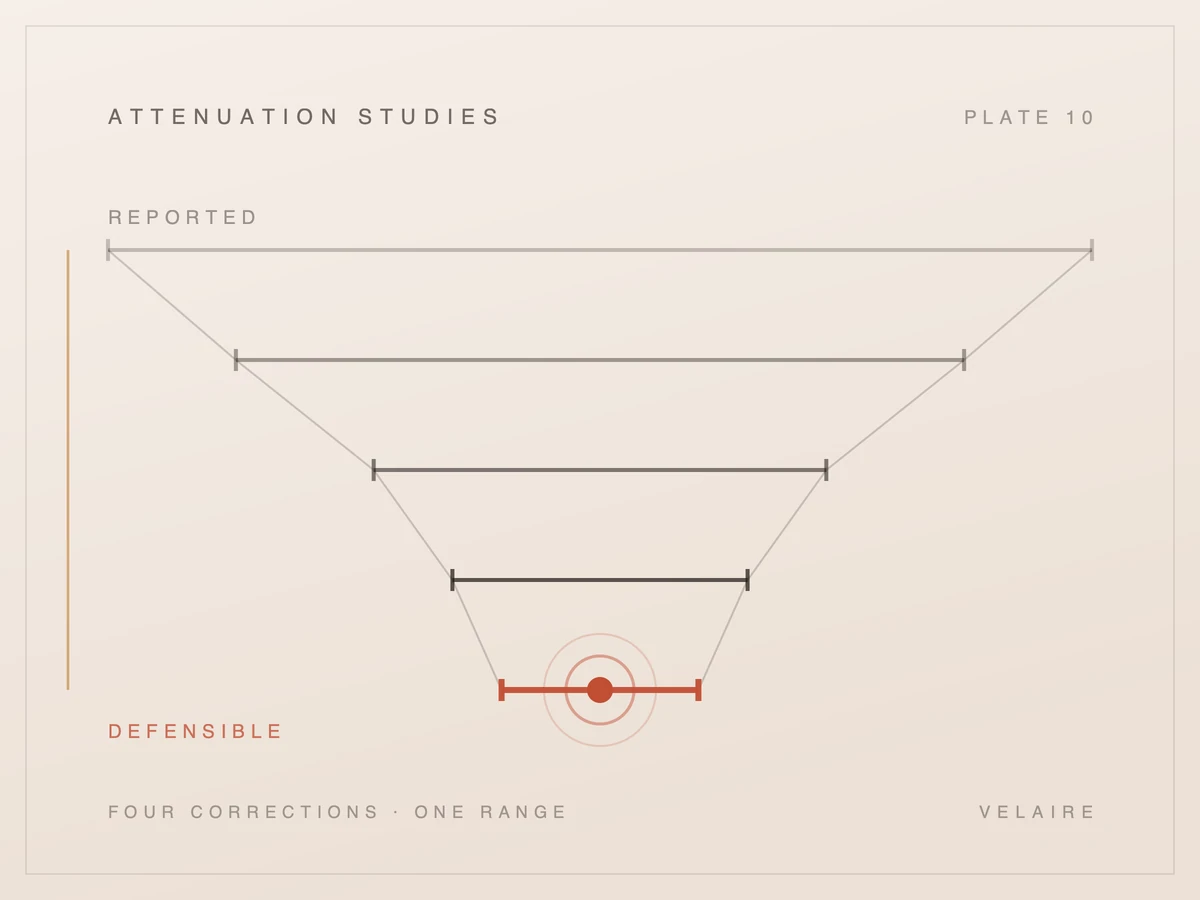
The other three are harder to see and larger in combination. None of them require a consultant to work out. All of them come from data you already have, and the point of assembling them is not to argue for cutting anyone. It is that any decision about phone coverage, extra hours, or software gets compared against the wrong number until you have all four.
A front-desk salary is public information and the easiest of the four figures to establish. You already know yours exactly, which is the point of starting here: it is the one number in this article you do not have to go and calculate, and it is the number every other cost gets quietly compared against.
For a sanity check against the market, national wage data puts the median for medical secretaries and administrative assistants at $22.08 an hour, or $45,930 a year, as of 2025 [1]. That is worth knowing if you are modelling a role you have not filled yet, or checking whether your own number sits above or below where candidates in your area expect it to be.
Treat this as the anchor and nothing more. It is the only one of the four numbers that a payroll report gives you directly, and it is the only one that stays flat whether the phone rings 40 times a day or 400. Everything expensive about a front desk is downstream of that ringing.
Two adjustments make the anchor honest before you go further. Add employer taxes and benefits, which a practice manager can pull in a few minutes. Then divide by the hours that are genuinely spent on the phone rather than on rooming, intake, checkout, and everything else the role absorbs, because otherwise you are attributing the whole salary to one of its several jobs.
Salary is the only one of the four numbers that does not move when the phone gets busier.
Replacing a front-desk hire costs recruiting time, onboarding time, and a stretch of reduced output while the new person learns your practice. It is the largest single swing in the four, and unlike salary it varies enormously between practices in the same town.
The good news is that the market has stopped getting worse. In MGMA polling, around 70% of practices reported turnover the same as or lower than the prior year, split evenly between the two, while 29% said it had risen [2]. Stabilised is not the same as solved, and front office remains one of the roles most often named as a hotspot.
Turnover, as practices report it
70%
report turnover flat or lower
split evenly between the two
29%
report turnover higher
47%
name medical assistants hardest to recruit
against 15% for nurses
MGMA polling on year-over-year turnover, and on which roles are hardest to fill.
Recruiting difficulty tells the same story from another angle. Asked which role is hardest to recruit, 47% of practice leaders named medical assistants, roughly triple the 15% who named nurses, ahead of billers at 10% and coders at 9% [2]. Front-desk and clinical support roles compete for overlapping candidates in most markets, so a hard MA market is rarely an easy receptionist market.
What practices actually do about it is worth knowing before you assume money fixes it. Asked for their most effective retention tactic for front-desk staff specifically, leaders split evenly: 33% said higher pay and 33% said engagement [3]. That is a genuinely even split, and it means half the practices that solved this did not solve it by paying more.
The number you want for your own model is simple. Take the months a front-desk seat sat empty or half-productive in the last two years, and multiply by what that seat produces in a month. Most practices have never calculated it and are startled by the result.
A week has 168 hours. A practice open eight hours a day, five days a week, is staffed for 40 of them. That is not a rounding error around the edges of the business, it is 24% of the week, and calls keep arriving through the other 128 hours whether anyone is there or not.
This is the number that resists being solved by hiring, which is what makes it structural. Adding Saturday mornings adds four hours. Adding a late clinic one evening a week adds three. Both are real operational commitments and neither meaningfully changes the shape of the week.
The staffed week
Staffed40 hrs
Uncovered128 hrs
A standard schedule covers 40 hours. Calls arrive across all 168.
The reason it belongs in a cost model rather than a scheduling conversation is that the uncovered hours have a price even though nothing appears on a payroll report for them. Whatever share of your inbound demand arrives in those 128 hours is being handled by voicemail, by a callback the next morning, or by nobody.
Sizing it does not need new software. Your phone system already records call times, and one export sorted into open hours and closed hours gives you the split for your specific practice. The worked version of that exercise takes an afternoon and produces a number you can defend.
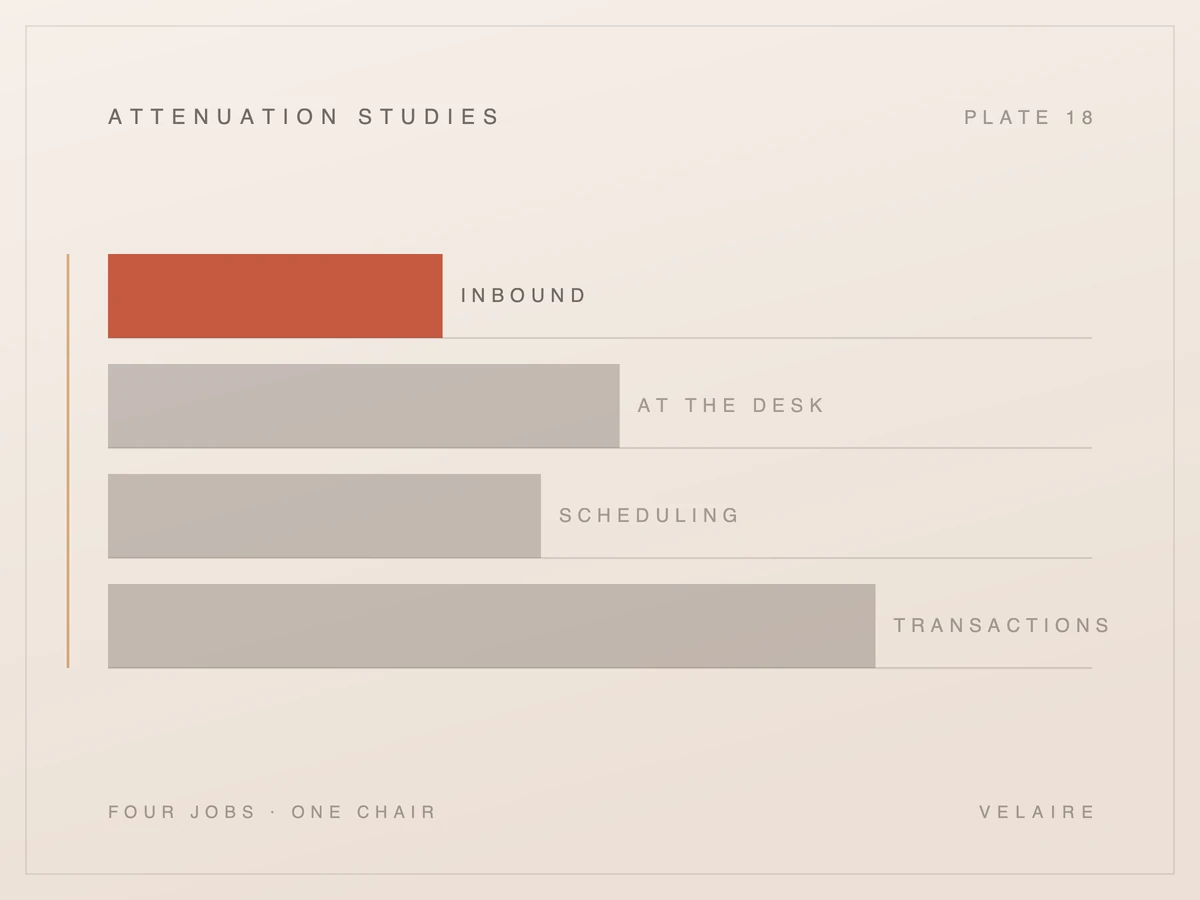
The fourth cost is the one practice owners describe constantly and quantify never. A receptionist handling a checkout while the phone rings is doing two jobs badly at once, and the patient standing at the desk is usually the first person to notice it happening. Nobody bills for that, and no report records it.
It shows up as small failures rather than a line item. A caller who waits on hold and hangs up. A message taken accurately but never actioned because the person who took it got pulled into something else. A recall list nobody has worked in three weeks because there was never a quiet twenty minutes to work it.
What makes this cost slippery is that every individual instance looks trivial and forgivable. One hold that ran long is not a problem. One message that sat until Thursday is not a problem. The cost lives in the rate rather than in any single event, which is exactly why it never appears on a report and why the people closest to it describe it as a feeling rather than a figure.
Patients have a view on this that is worth taking seriously, because it cuts against the usual assumption. In a 2024 survey of 1,000 US adults, 42% said they were comfortable with AI scheduling routine appointments, and among patients dealing with sensitive health issues, 67% said they would be more comfortable booking through an online chatbot than with a person [4]. The same survey found 81% still wanted a human for actual medical advice, which is the line worth respecting.
Half the practices that fixed front-desk retention did not fix it by paying more.
The practical version of this cost is a question rather than a formula: how many times a day does your front desk get interrupted mid-task, and what is the failure rate on the task that got interrupted? Nobody has a source for that. You can watch it for a week.
Once the four numbers exist, the options in front of a practice stop looking like they belong in the same category. A part-time hire, an answering service, and an automated front office solve different subsets of the four, and a comparison that treats them as three prices for one thing is the most common way this decision goes wrong.
A part-time evening hire moves the coverage number and nothing else. It adds staffed hours, which is real, but it also adds a second exposure to the turnover number and does nothing about interruption during the day, because the interruption happens at 11am when the new person is not there. Practices frequently discover the fourth cost is the one they most wanted fixed.
An answering service moves coverage and leaves the rest alone. Calls get picked up outside hours and come back as messages, which means the work still lands on the same desk the following morning, competing with the same walk-ins. It converts a missed call into a task, and a task is not the same as a resolution.
Automated coverage moves coverage and interruption together, because a call that never reaches the desk is not an interruption at the desk. What it does not move is turnover, and it does not remove the need for a person, since anything clinical or ambiguous still has to reach one. Any vendor implying otherwise is describing a product that does not exist.
Which cost each option moves
Part-time hire
Automated coverage
Salary and on-costs
Adds to it
Adds a smaller fixed line
Turnover
Adds a second exposure
Unchanged
Uncovered hours
Improves the hours worked
Covers all 128
Interrupted attention
Unchanged during the day
Improves during the day
Three options against the four costs. None of them moves all four.
The reason to lay the three side by side is that the honest answer for a lot of practices is a combination, or nothing at all. A single-location practice with light evening demand and a stable front desk has no problem worth spending on. A practice with 128 uncovered hours, a seat that has turned over twice, and a desk that gets interrupted forty times a day has three separate problems, and buying one solution for all three will disappoint on two of them.
None of the four numbers is hard to produce, and none of them requires software to establish. Two come out of records you already keep, one needs a single phone-system export, and the last needs a week of paying attention. Assembled, they answer a different question from the one a salary line answers on its own.
Cost
Where the number comes from
Moves with call volume
Salary and on-costs
Payroll, plus taxes and benefits
No
Turnover
Months of vacancy in the last 2 years
Indirectly
Uncovered hours
Phone export split by open and closed
Yes
Interrupted attention
One week of observation
Yes
The reason to assemble all four is not to build a case for replacing anybody. It is that three of them move with call volume and the one everyone quotes does not, so a practice that only knows its salary line is comparing every coverage decision against the one number that stays still.
It is also worth being honest about the precision available here. Two of the four are estimates and will stay estimates, because no practice runs a controlled experiment on its own vacancy months. A range you can defend beats a decimal you invented, and the decision this feeds is usually directional rather than fine-grained.
Where each number comes from
1
Salary and on-costs
Payroll, plus employer taxes and benefits, divided by the share of hours actually spent on the phone.
2
Turnover
Vacant or half-productive months across the last two years, times monthly contribution of the seat.
3
Uncovered hours
One phone-system export, sorted into open hours and closed hours.
4
Interrupted attention
One week of counting interruptions and the tasks that failed because of them.
None of the four needs software to establish. Two need an afternoon.
That comparison is where most decisions in this category actually go wrong. A practice weighing an evening receptionist, an answering service, or an AI front office against a $45,930 salary line is answering a different question from the one it thinks it is asking. Against all four numbers, the arithmetic frequently reverses.
None of this says the answer is software. Some practices work the four numbers and conclude their coverage is fine, or that the fix is a rota change, or that the real problem is a recall list rather than a phone. That is a legitimate outcome and a cheaper one. What is not legitimate is deciding either way on a salary line alone.
If you want the shorter version of this exercise aimed specifically at the calls you are missing, the cost of a missed call works the same four-number logic in the other direction.
FAQs
Questions about this
Use your own payroll number, not the national median. The published figure of $22.08 an hour is useful as a sanity check on whether you are paying above or below market, and as a starting point if you are modelling a role you have not hired yet. For your own model you already know the real figure exactly.
Count the months in the last two years when a front-desk seat was empty or filled by someone still learning, then multiply by what that seat contributes in a normal month. It is a rough figure and it does not need to be precise. Most practices find it is larger than any software they were considering.
Not by much. A Saturday morning adds around four staffed hours to a week that has 128 uncovered ones, so the ratio barely moves. Weekend hours can be worth doing for other reasons, including patient convenience and competitive positioning, but they should not be sold internally as a fix for coverage.
It depends heavily on what they are calling about. Survey data suggests a substantial share are comfortable with automated scheduling for routine appointments, and some prefer it for sensitive topics. The same data shows a strong preference for a human on anything clinical, which is the boundary any system covering your phone has to respect.
Then you have a defensible answer and you can stop, which is a legitimate and cheap outcome. The exercise is worth doing precisely because it sometimes ends there. What it prevents is spending on coverage you did not need, or declining coverage you did, on the strength of a salary line that answers a different question.
Builds AI front-office systems for medical and aesthetic practices. Posts here start from published sources rather than vendor claims, and every number links back to where it came from.
Eligibility checks, prior authorisations and claim status inquiries have measured per-transaction costs. Automating your phone does not touch any of them, and it is worth knowing that before you buy.
The patients most likely to book are the ones you have already treated. Here is why the contact rate is the number that matters, why recall is not marketing under HIPAA, and why the list decays quietly.
Reminders work. They work less dramatically than the marketing suggests, and the honest number is a 10.8 point improvement rather than the 14.6 point one everybody quotes. Here is what the trials found.
Nine lessons that turn one month of call records into a defensible range for what your missed calls are costing. No new software, no vendor stat sheets, and an honest answer at the end even if it is small.
Skip the vendor stat sheets. Four numbers you already have will tell you what a missed call is worth to your specific practice, and whether covering them is worth paying for.
When a US practice needs a business associate agreement with an AI phone agent vendor, what the agreement must cover under HIPAA, and what to request before call data flows.
The plain-language explainer: what it does, what it deliberately doesn't, and how it compares with voicemail, an answering service, a phone tree, and hiring.